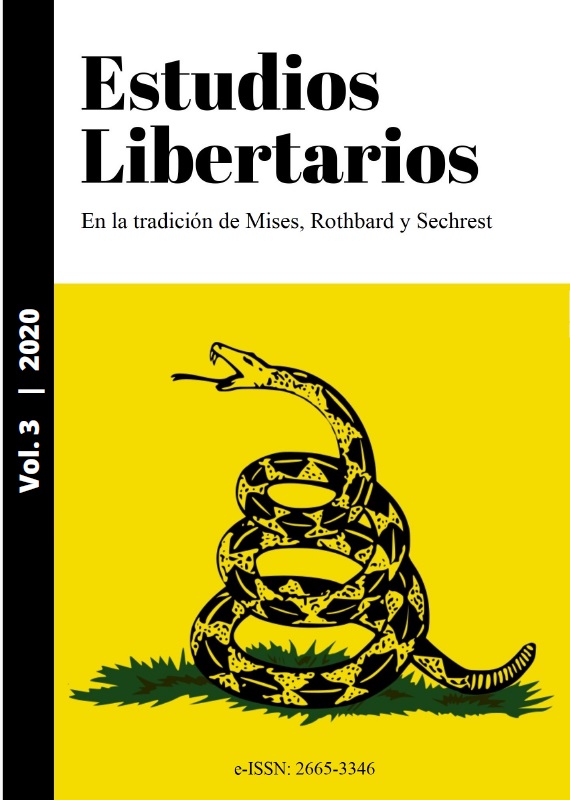
For the third consecutive year, we are pleased to present a new volume of Estudios Libertarios. This third edition coincides with a particularly significant period in recent history: 2020, a year marked by the health emergency resulting from a pandemic. While this exceptional context is present in some of the contributions gathered in this volume, it has not entirely defined our editorial agenda. We believe that, even in times of uncertainty, academic work on libertarian thought must continue to broaden its horizons.
Consequently, this edition brings together works dedicated to topics as diverse as feminist economics, literature, and the critique of totalitarianism from applied perspectives, in addition to incorporating a greater number of reviews and translations that enrich the intellectual dialogue. Furthermore, reaffirming the international character of the journal, we have the participation of authors from Venezuela, Spain, Italy, Poland, Colombia, and Chile.
We trust that this volume will be of interest to our readers and will contribute to stimulating the critical reflection and intellectual curiosity that inspire the spirit of Estudios Libertarios.
Length: 167 pages.
Complete volume
Presentation
Artícles

Desocialization of Taxes: A Taxation System Proposal for Venezuela
Rafael Acevedo, Luis Cirocco & María Lorca-Susino
This paper proposes a tax reform for Venezuela, based on municipalization, simplification of the system and the adoption of market principles, measures that would restrict interventionism and hinder the application of centralized planning policies.

La economía feminista a la luz de la teoría de la Escuela Austriaca
Vicente Moreno Casas
An analysis of feminist economics from the perspective of the Austrian School, identifying coincidences, criticisms, and possible points of convergence between both approaches.

The Italian Financial Novel: Finance as Told by Financial Professionals
Stefano Adamo
This article analyzes four recent Italian novels about the financial world written by former or current banking professionals. Through literary analysis and interviews with their authors, it examines how they portray finance and the ideas they convey in the wake of the 2008 and 2011 financial crises.

The Problem of Information War in the Framework of Natural Law…
Agnieszka Płonka
Propaganda and ideological subversion aim to incite political aggression, but combating them legally would violate natural law itself. These strategies only thrive in societies with already excessive political power.
Book Reviews
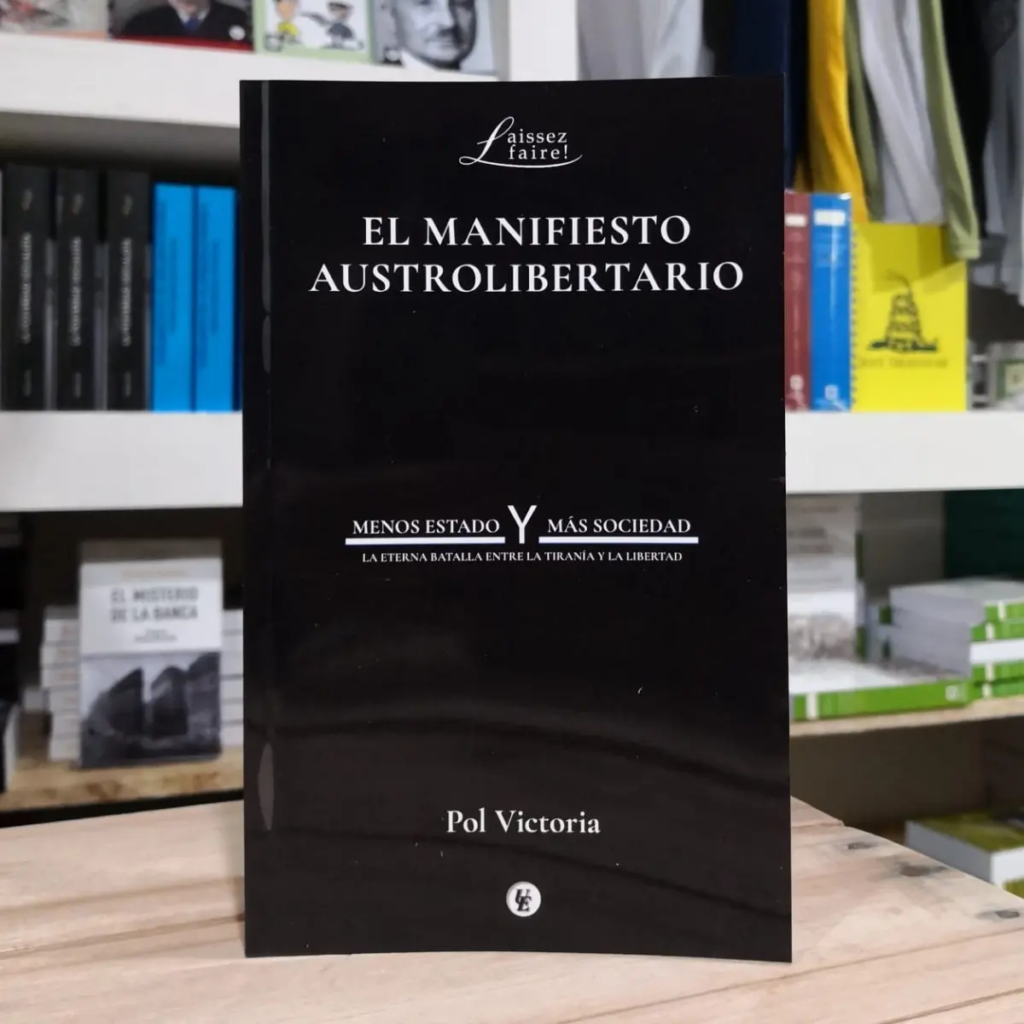
Book Review 1: “El Manifiesto Austrolibertario”
Gilberto Ramírez
Pol Victoria’s Manifiesto Austrolibertario is the first systematic exposition of Austrolibertarianism, grounded in the Austrian School, libertarianism, and natural law. It emphasizes his defense of liberty, individual responsibility, private property, and a state limited to protecting the natural order.
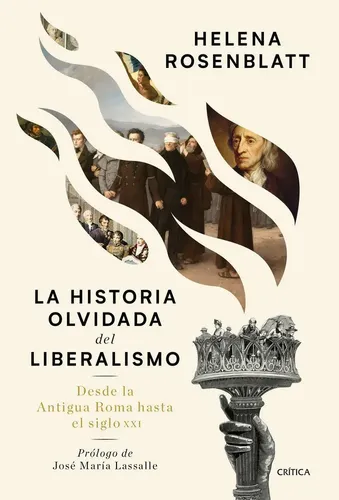
Book Review 2: “La historia olvidada del liberalismo”
Carlos Goedder
Helena Rosenblatt reconstructs the history of liberalism as a diverse tradition with deep ethical roots and a commitment to social welfare, extending beyond the contemporary emphasis on individual rights. She also reveals its historical evolution, internal debates, and contradictions, highlighting its intellectual richness in the face of simplistic views.

Book Review 3: “Green Market Revolution: How Market Environmentalism…”
Lorena Muñoz del Campo
The review critically analyzes the global environmental crisis. It argues that responsibility is collective and that the focus should be on transforming the economic system into a sustainable one, rather than on political debates about historical blocs. Finally, it defends the need for new models of markets, governance, and incentives.
Translations

Translation 1: “El cálculo económico en la comunidad socialista”
Author: Ludwig von Mises
Translator: Gilberto Ramírez Espinosa
In 1919, Mises developed a critique of interventionism and socialism, which he presented in a 1920 lecture and later published as “Economic Calculation in the Socialist Community,” refuting central planning. On its centenary, the journal “Estudios Libertarios” highlights the importance of this work and its translation into Spanish.

Translation 2: “Competencia perfecta: Un caso de ´falla de mercado´”
Authors: William Barnett II, Walter Block & Michael Saliba
Translator: Dusan Vilicic Held
The paper analyzes the market for goods and services as a mechanism of corporate governance, focusing on perfect competition. It argues that orthodox economics does not adequately incorporate the concept of opportunity costs or forgone alternatives.
Based on this, it discusses implications for industrial organization and antitrust policy.
News

News 1: Carta abierta a los lectores de “Estudios Libertarios”
David Chávez Salazar
The author criticizes catastrophism and nihilism in the face of the pandemic, both considered harmful extremes. Instead, he proposes an intermediate stance based on “negative visualization” to mitigate risks with restraint; and he argues that the crisis was partly foreseeable and that the response should prioritize freedom and decentralization.

News 2: Entrevista al Editor en Jefe de “Estudios Libertarios” por el AEC
Editorial
The text summarizes an interview with David Chávez Salazar about the pandemic in Latin America, with an emphasis on Colombia, Chile, and Brazil. He criticizes lockdowns for their economic impact and the expansion of the state, and points to social fear as a factor that legitimizes these measures; he also highlights the role of the private sector.
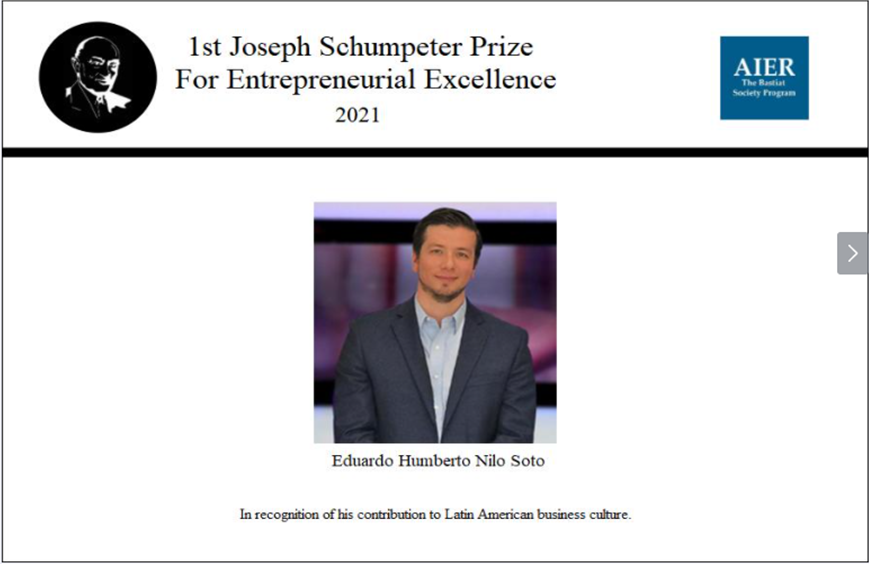
News 3: Primer Premio “Joseph Schumpeter a la Excelencia Empresarial”
Editorial
The “Joseph Schumpeter Award for Business Excellence” was created to recognize entrepreneurs linked to free markets and innovation. The first edition honors Chilean entrepreneur Eduardo Humberto Nilo Soto for his career in business, academia, and technology in Latin America.
Instructions for authors
Cover back