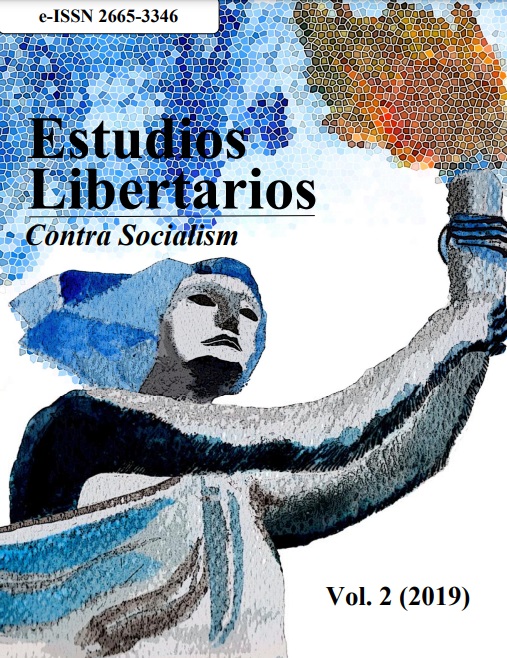
We are pleased to present Volume 2 of Libertarian Studies. Following the excellent reception of our first issue, this new edition reflects a process of consolidation and strengthening of the publishing project. Among its main advances are the incorporation of a peer-review system, the creation of new thematic sections, and the acquisition of an e-ISSN and Legal Deposit at the National Library of Colombia.
This volume brings together research that examines and critiques socialism from diverse theoretical and historical perspectives. It also features contributions from authors from Poland, the United States, Ecuador, Brazil, Sweden, Argentina, Colombia, Costa Rica, and Austria, demonstrating the journal’s growing international reach and its commitment to disseminating Austrian libertarian thought from different parts of the world.
Lenght: 169 pages.
Complete volume
Presentation
Artícles

An Assault on the Individual: A Preliminary Comparative…
Agnieszka Plonka
Socialism reproduces patterns characteristic of narcissistic personality disorder. Therefore, the article argues that strategies for coping with narcissistic abuse can also be used to resist state propaganda and intimidation.
Effective Self-Ownership and Property Schemes: Comment on…
Christian Torsell & Walter E. Block
Private ownership of extracorporeal resources is better suited to effective self-ownership than collective ownership, by facilitating access to and use of those resources. A critique of G.A. Cohen’s argument.

La deflación en el Ecuador: Una visión conjunta desde la Escuela Austriaca…
Leonard de Jesús Quinde Allieri
Deflation is not necessarily harmful, especially in a dollarized economy like Ecuador’s. Businesses can adapt by reducing costs and improving processes, without resorting to inflationary policies or government intervention.

Entrepreneurship versus Communism: Economic Calculation, (Black) Markets…
Fernando Monteiro D´Andrea, & João Daniel Ruettimann
Entrepreneurship does not disappear under communism, but rather adapts to the constraints of central planning. It emerges through informal economic calculation, black markets, and the search for opportunities.

The Swedish Lesson: The Welfare State Destroys Itself
Nima Sanandaji
The Swedish welfare state generates moral hazard and weakens individual responsibility. The author argues that these dynamics undermine its sustainability and explain the reforms and difficulties it has faced over time.

Falacias de la educación estatal
Alberto Benegas-Lynch (h)
State-funded and state-controlled education restricts freedom and creates inefficiencies. As an alternative, educational freedom is defended as the foundation of progress and human development.

Pablo Victoria: El primero de los libertarios, el último de los conservadores
Gilberto Ramírez Espinosa
This article presents the thought of Pablo Victoria, highlighting his intellectual contributions. It summarizes his ideas on economics, history, and philosophy, including free banking, his critique of Keynesianism, and a reinterpretation of Latin American history.
Reseñas bibliográficas
Book review “Prosperity & Liberty: What Venezuela Needs…“
David Gordon
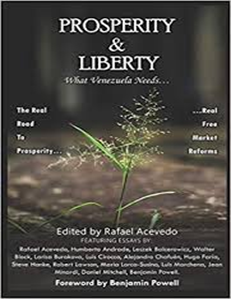
Prosperity & Liberty proposes a comprehensive plan to rebuild Venezuela through free-market reforms inspired by the Austrian School. It argues that the crisis is a consequence of decades of socialism and advocates rapid and profound liberalization as the path to restoring prosperity and freedom.
Traducciones

Translation 1: Capitalismo autoritario
Author: Toby Evans.
Translator: Jorge Corrales Quesada
This is an examination of whether authoritarian capitalism is a viable alternative to its liberal Western version, in order to promote long-term economic growth and development.

Translation 2: Fallas de mercado en el sector aeroportuario y contraposición…
Author: Joao Fernando Rossi Mazzoni.
Translator: David Chávez Salazar
The article analyzes the economic regulation of the airport sector by comparing the approaches of neoclassical economics, the Austrian School and the Public Choice School.
Noticias
Victoria Schmid.
The Free Market Road Show 2019, an international event dedicated to discussing economic freedom, entrepreneurship, and the role of the state, took place. Participants warned about the risks of centralization and the advance of socialism in Europe.
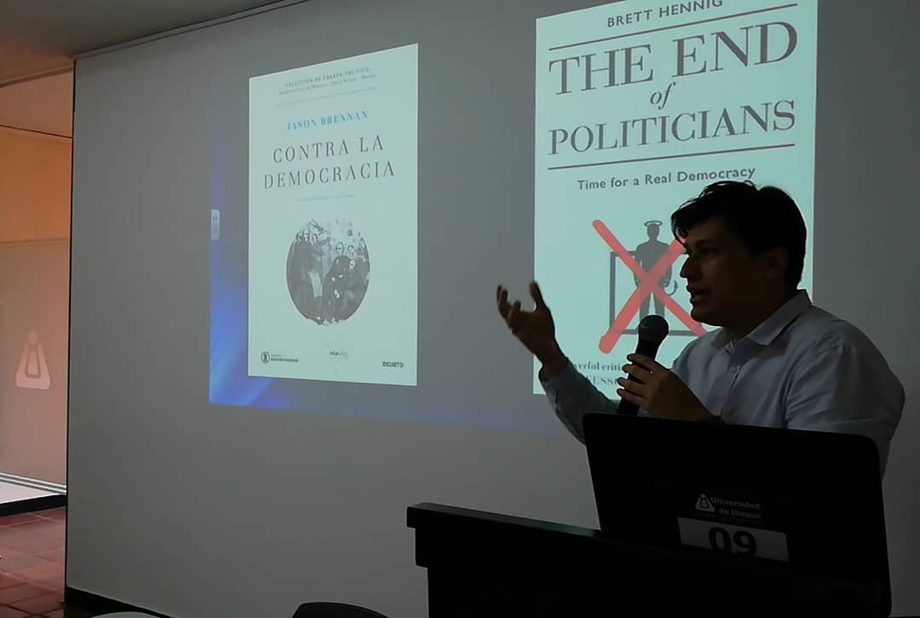
Alejandro Bermeo
The co-founder of “Estudios Libertarios” presented a paper on demarchy as an alternative to the current system. Contemporary democracies are not democracies in the classical sense, and selection by lot would promote greater representativeness, independence, and transparency.
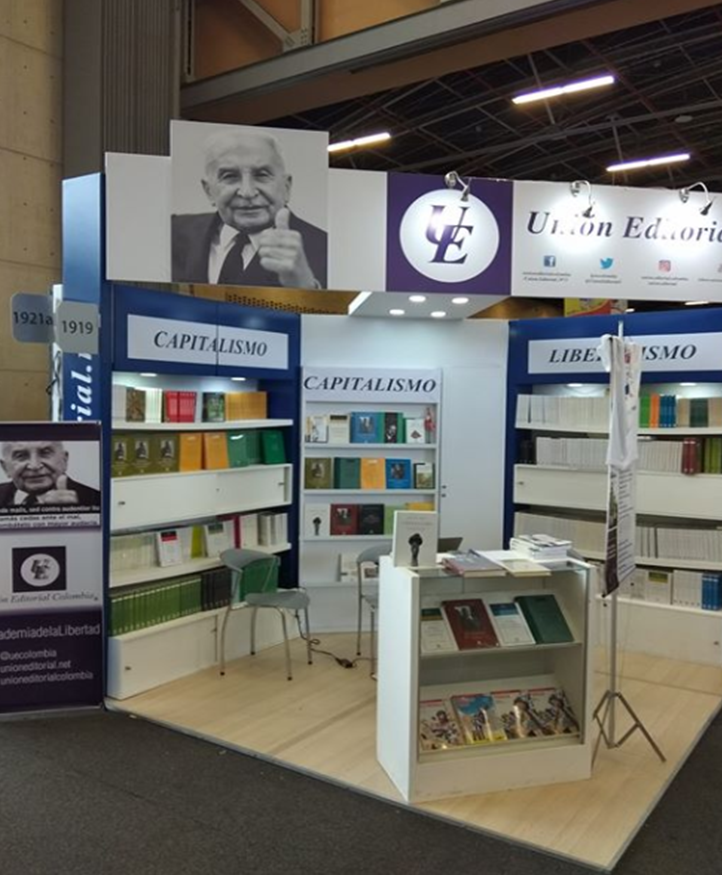
Gilberto Ramírez Espinosa
Unión Editorial Colombia participated in the 2019 Bogotá International Book Fair, where it promoted works of the Austrian School and libertarian thought. The presentation of several books was also highlighted as part of its strategy to strengthen the dissemination of liberal ideas in Colombia.

David Chávez Salazar
A tribute to Larry James Sechrest, highlighting his contributions to free banking theory. The author emphasizes his academic legacy, his commitment to disseminating the ideas of liberty, and Estudios Libertarios’ decision to include him as a key figure in the journal.
Instructions for authors
Cover back