Hanson, C., Block, W., & Acevedo, R. (2021). Venezuela: The Downfall of Promise. Estudios Libertarios, Vol. 4, 1-31.
CHRISTIAN HANSON*, WALTER E. BLOCKY, & RAFAEL ACEVEDOf
Resumen
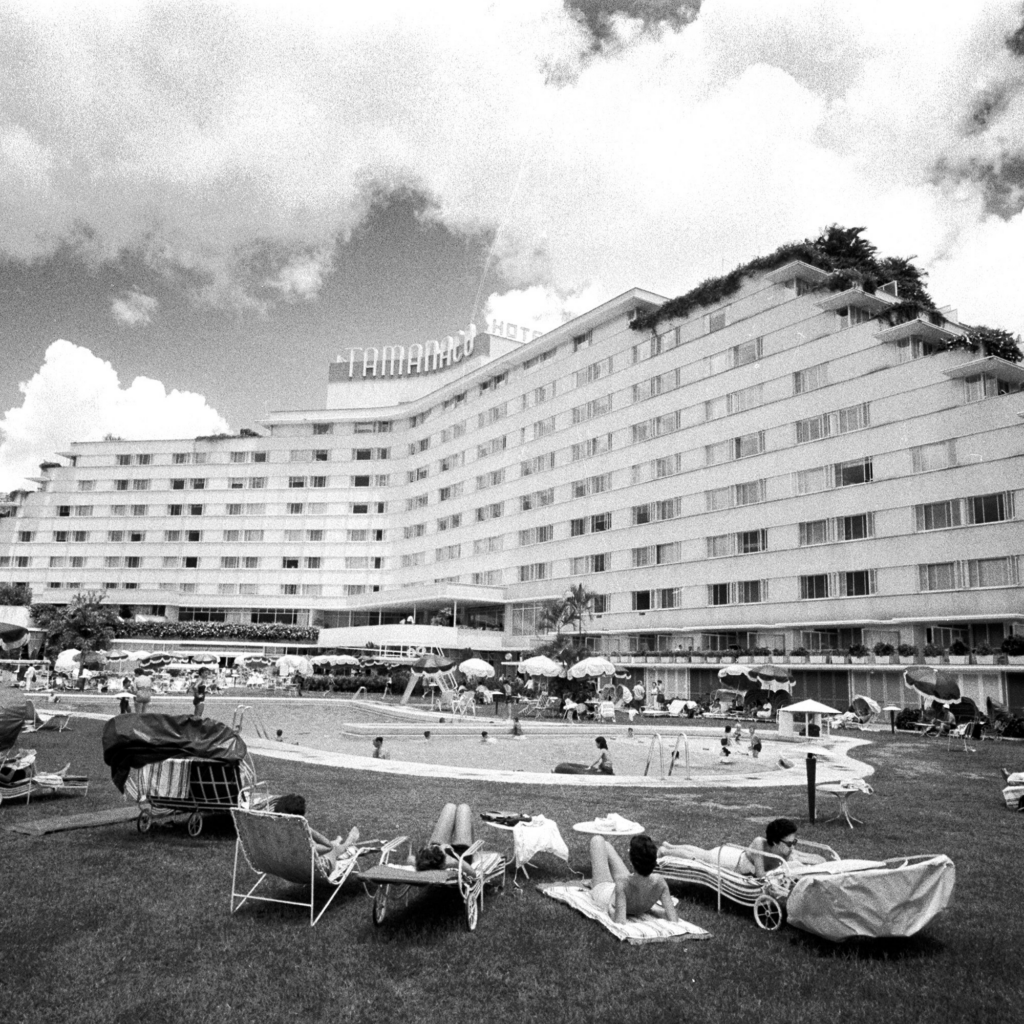
En la década de 1950, el próspero negocio petrolero – junto con un marco legal respetuoso de la propiedad privada – convirtió a Venezuela en uno de los países más ricos del mundo. De ahí que muchos llegasen a pensar que en cuestión de años el país suramericano se
convertiría en una nación del Primer Mundo. Setenta años después la realidad es otra: Venezuela es un país azotado por la pobreza, la hiperinflación y el caos institucional. ¿Qué fue lo que ocurrió? ¿Por qué Venezuela dejó de ser la gran promesa de América Latina para ser el país más menesteroso de la región?
Contrario a la opinión popular, el declive de la nación caribeña no comenzó en 1998 con la llegada de Hugo Chávez al poder, sino cuarenta años atrás, en 1958, con la caída de la dictadura del General Marcos Pérez Jiménez y el advenimiento de la (social) democracia. Desde entonces, cada gobierno puso su aporte en la destrucción del libre mercado.
En esta investigación se documentan las diferentes reformas implementadas por los gobiernos que tuvieron lugar entre 1958 y 1998, los cuales forjaron un legado de destrucción del libre mercado, basado en medidas como los controles de precios, alquileres y cambios; establecimiento del salario mínimo; barreras al comercio internacional; cartelización del sector petrolero; nacionalizaciones y espirales inflacionarias. El golpe final se daría en 1999 cuando el chavismo llegó al poder. Fue entonces que se aplicaron las tres políticas que dieron la estocada final a la economía venezolana: la nacionalización desbordada de la empresa privada, controles más estrictos de divisas y precios, y agresivos programas de “bienestar social”.
A partir de un análisis basado en la teoría económica austriaca, la economía política y la Historia, los autores afirman que Venezuela puede volver a la senda de prosperidad de la que disfrutó en la década de los 50 si establece un sistema de libre mercado puro, ajeno tanto al marxismo como al keynesianismo.
Palabras clave: Venezuela; Petróleo: Socialismo; Pobreza.
Clasificación JEL: P20.
Fecha de recepción: 18 de marzo de 2021.
Fecha de aceptación: 16 de junio de 2021.
- Introduction1
Venezuela, a country on the northern coast of South America, was once a great economic power with the possibility of becoming a first-world country. The oil business gave many corporations and the people of Venezuela great wealth. The news of the financial success of semi laissez-faire capitalism spread throughout the world, but sadly the prosperous time would soon end in that country. The Venezuelan government started to chip away at the economic freedom the oil industry once had. It began sowing the seeds of destruction in 1950, and continued deterioration of economic freedom levels throughout the decade (Acevedo & Cirocco, 2017).
In 1958, The Venezuela dictatorship was overthrown and became a democracy. The democratic government gave benefits such as civil liberties, freedom of the press, and universal suffrage to the people, but at the cost of economic freedom. Socialism started to grow in the shadows and made its full-bodied appearance when Hugo Chavez came into power. Radical socialism was introduced and led to the end of Venezuela’s economic miracle. This downfall of efficiency creates the question «of what went wrong?» This paper will answer this question by analyzing the different “reforms” put in place by the Venezuelan government, how they led to the downfall of a once promising nation, and how capitalism still has the ability to save it.
2. A Semi Laissez-Faire Capitalism
To comprehend Venezuela’s downfall, people first need to understand the differences between free-market capitalism and socialism and be acquainted with at least a brief political-economic history of this country. When a country takes a free-market approach, it is based on private property rights and individual initiative with little or no government intervention into the economy. The government would have little or no impact on the economy, and privatized companies would control what happens in the country (Gwartney, 1996)2. The free-market approach made Venezuela an «economic miracle» due in great part to the government not managing the oil business or owning the wells (Acevedo & Cirocco, 2017).3 Corporations were free to do business and were not heavily taxed, which lead to a rise in livelihoods in the nation. Entrepreneurs flocked towards this land because of the economic opportunity the country presented. These actions led to Venezuela becoming at one time the wealthiest country in South America (Brodie, 2017).
When people gain wealth, they move out of their id-state and into that of a superego (Freud, 1927). They are no longer concerned with just their basic human needs of survival but are inclined to increase government services and to promote charitable giving in the community. People are inclined to help others, but sadly corruption all too often raises its ugly head. In the case of Venezuela, socialism played this role.
What is Socialism? It is a political and economic system that mandates all means of production be owned and regulated by the state. This sounds lovely at least to many young people.4 But does it work? There has never been a prosperous socialist country (World Population Review, 2020). To the extent there are exceptions to this general rule, it is in spite of this system, not because of it.5
There are three main critiques of socialism. If government owns all the means of production, no market prices can be generated. Without them, the central planning commission is flying blind. For example, platinum makes a better railroad bed than steel; but its price is far too high to allow any such use. But without a price system that indicates this economic reality, resources are misallocated. Mises (1922) stressed this element. Hayek (1935A, 1935B, 1940, 1948) focused on the information that market prices conveyed. But, again, without a market, little of this is possible. The first five years of the U.S.S.R. (1917) the authorities ignored western prices. This made the economy so inefficient even in the eyes of those in charge of it that they instituted market prices in their New Economic Plan in 1921; now, for the first time they could avail themselves of information in the Sears catalogue. The almost controlled experiments of East Germany, or North Korea ought to have put paid to this system, but people act as if they were “hard wired” (Levendis, 2019) to accept socialism despite these obvious counter examples.
In the next section we elaborate on a brief political-economic review of Venezuela to give readers the historical argument which demonstrates that the current crisis did not start with Chavez taking power. Rather, his rise to leadership was the result of a previous “progressive” application of socialist policies.
3. A Brief Political-Economic Review
By the 1950s when other countries were, recovering from the devastation of World War II, Venezuela possessed the fourth highest GDP per capita in the world, exceeded only by the United States, Switzerland, and New Zealand (University of Pennsylvania, 2016). In those years, Venezuela had twice the per capita income of Germany, four times that of Japan, and twelve times the income of China; but by 2012 Venezuela ranked as low as the 68th in the world in this regard (University of Pennsylvania, 2016). This was possible because after 1920 Venezuela began to exhibit a continuous increment of growth in its real GDP and achieved its highest value in 1958. This economic growth was mainly promoted by the oil boom and, contrary to the restricted political freedom observed in those years, the economic freedom that the country enjoyed during that period was strong (Bello, Blyde, and Restuccia, 2011).
Faria (2008) and Acevedo and Cirocco (2020) explain that the main characteristics of Venezuela’s economy are: i) The government received income from the oil sector only in the form of revenue taxes and selling concessions. ii) Private property was fully protected by government. iii) The marginal tax burden in this period was the lowest in its history, the rate on individual income was 12 percent. iv) There was a100% gold backed monetary system that made the national currency one of the strongest in the world.6
Other institutions were strengthened or even created. General Juan Vicente Gomez, president from 1908 to 1935, was committed to the pacification of a country with a history of more than a century of civil and pseudo-military revolts through the introduction of the rule of law7, constitutional prohibition of communism, and the alteration of a totally rural country into an industrialized one8 (Acevedo and Cirocco, 2020). All these characteristics promoted foreign private investment, and boosted a process of capital accumulation, knowledge transfer, social-political modernization, and economic growth9 (Bello, Blyde, and Restuccia, 2011).
After the death of General Gomez, his war minister General López Contreras took the power. He further restored civil liberties, allowed labor unions10 and other political rights. However, he created the Central Bank and diminished the gold reserves for backing the currency to 50%. He started a three-year development plan in which the State intervened by building public schools and hospitals, other major infrastructures, credit programs, and other interventions. However, despite these moves in the direction of socialism, the government continued with a policy of relatively low interventionism, and the State owned just the 30% of the Central Bank (Cordeiro, 2016); the rest was in private hands.11
General Medina Angarita succeeded Lopez Contreras and began a democratization process. The governmental income decreased, given the diminishing of the oil revenues between 1941 and 1942 (due to World War II). Medina changed the oil industry enactment to the “Hydrocarbons Law” in 1943, which increased the state’s share of profit but granted new concessions to private companies for forty years. Medina was overthrown in 1945 by a civilian- military revolt. Romulo Betancourt, a Venezuelan-renowned member and founder of communist parties around Latin America, headed the revolt and ruled the country until 1948 when, for the first time, Venezuelans could vote to elect their president. The new president, the writer-novelist Romulo Gallegos, ruled for just nine months due to a military revolt and Colonel Carlos Delgado Chalbaud became the president of the new military board. In 1950, Chalbaud was assassinated, and General Marcos Perez Jimenez ruled the country from the Ministry of Defense, formerly the War Ministry. It was in December of 1952 that General Marcos Perez Jimenez officially ascended to the presidency.
Perez Jimenez had a nationalist approach; he strengthened law and order and personal security, but completely restricted political liberties. His economic policies were devoted to industrializing the country to achieve the economic development that his plan had as its objective. The bulk part of public expenditures was dedicated to big infrastructure projects such as roads, hospitals, housing complexes for low-income families12, highways, a network of public hotels, electricity plans, freshwater reservoirs, research and scientific institutes, seaports, airports, subsidized loans to early stages of production industries, and even the construction of a nuclear plant.
Jimenez’s relatively free market policies promoted economic development. Bello, Blyde and Restuccia (2011) explain that Venezuela ascended from being the South American country with the lowest capacity of electricity generation (in 1950) to having the second highest capacity (in 1959). In addition, the country was the first Latin American economy with manufacturing and electricity-gas-water sectors exhibiting an annual average growth rate of 11.2% and 18.1% (Faria and Montesinos, 2016; Faria and Filardo, 2015; Faria, 2007 and 2008).
In January 1958, General Perez Jimenez was overthrown and the social-democratic and social-Christian era in Venezuela, or the 4th Republic, began. In charge was Romulo Betancourt, the first elected president of this period, who had promoted the coup d’état of 1945. The new administration moved in a different direction. Betancourt introduced a series of socialist and state interventionist policies including the devaluation of the currency, price, rent and exchange controls. The rent seekers and cronies started to increase their influences; they promoted an aggressive import substitution plan that included high tariffs and quotas; “national families”13 started to create vast wealth through political influences. Mainstream economists also promoted the creation of a Central Planning of the Economy Ministry and the adoption of the five-year plan (following the Soviet Union tradition). Marginal tax rates were increased.
Betancourt, as did Chavez, promoted a new constitution that eliminated virtually all economic freedoms and jeopardized private property14. Another important reform was the change in the Central Bank law, decreasing gold reserves to 33 percent backing for the currency and giving full rights to the government for the election of the Central Bank’s Board of Directors; it eased the monetization of the debt (Cordeiro, 2016).
However, it seems that Venezuelans forgot the ideological roots of Betancourt. Currently, some “rightists” or “conservatives” are defending him as “the father of the democracy”15 forgetting that Weyl (1960) said “Rómulo Betancourt had become the leader of the Costa Rican Communist Party at the age of 22” (p. 3). This author also explained that “there is no dispute whatsoever about the powerful support which Betancourt gave the 26th of July Movement”16(p.141). However, people argue that once Betancourt took power as the first president of the Social-Democrat era in Venezuela he was a fierce opponent of Castro’s project. But that does not erase the historical fact that he was a strong supporter and old friend of the Cuban dictator “Castro’s old friend from Bogotazo days, President Romulo Betancourt” (Weyl, 1960: p. 141)17. Neither circumstance erases the fact that his network was the typical hard socialism of Latin American politicians (Sosa, 2001).
Betancourt deserves that attention because he played one of the main roles in the movement from the Andean to the Social-Democrat era. This is a fact that nobody can deny. Nevertheless, an unbiased analysis of his ideological roots will end in the same direction. Romulo Betancourt was a fierce promoter of the communism and anti-imperialism in his early life and of democratic socialism after he became president in 1959. Schwartzberg (1997) explains that in the 30’s Betancourt:
…did for a time agree with [Trostky’s and Lenin’s] fantastic vision of themselves as the
leaders of a Soviet Union in the vanguard of a progressive and historically necessary global
transformation… [and] he [Betancourt] became an articulate member of the antidemocratic
left – someone who clearly expressed the view that democracy itself would ultimately be an
obstacle to the kind of social revolution which was desperately needed.” (p. 618)
The relation of Betancourt and the leftist movement was widely and international recognized. On August 31st, 1965, the official remarks of Hon. James Utt of California included an article written by Harold Lord Varney that states “My last sight of Venezuela had been in the closing months of the Presidency of Marcos Perez Jimenez before the Leftist revolution which brought Romulo Betancourt back to power” (A4906). Some commentators try to whitewash Betancourt’s communist ideology because, after he became president, he was indeed an opponent of Castro’s project. Liberals18 threaten unbiased scholars and writers if they dare to write something critical of Betancourt in this context.
They rationalize their position by saying:
Betancourt has fought the Communists” – disregarding the open fact that he has fought only
his propaganda rival, Fidel Castro, while advancing his own brand of “communism under
another name” with impunity… [liberals] have made Betancourt’s name so holy that no
writer who wants to make a living dares to attack him. (A4908).
Many more articles, and official documents from organizations like the CIA, released after 2010, support the real origins of the ideology of Romulo Betancourt. However, the objective of this article is another different from analyzing Betancourt’s ideology, which could be addressed in further research.19
After Betancourt, in 1963, Raul Leoni – another Social Democrat – won the election and continued deepening state interventionism. He established the minimum wage law and raised barriers to international trade. This increased the cost of living of Venezuelans and benefitted the economic elite who were competing with entrepreneurs from other nations. Along with his Minister Pablo Perez Alfonzo, president Leoni would have to be remembered as one of the main culprits of the creation of the worst of international cartels, OPEC.
Following Leoni, Rafael Caldera won the presidential election in 1969. This social Christian politician required private companies to have majority ownership by Venezuelans, nationalized the natural gas companies, and promoted a “peace deal” with the communist guerrillas. Caldera’s “pacification deal” —very similar to what Juan Manuel Santos’ did in Colombia20—paved the way for these criminals to take places in the political arena and as scholars in public universities (Acevedo, 2021).
Virtually the complete institutionalization of the lethal mix of socialism and cronyism took place in 1975 when the government, presided over by the social-democrat Carlos Andres Perez (CAP) in his first mandate, nationalized the oil and other basic industries. At that time, the Hydrocarbons Law of 1943 was still relevant for the oil sector; the private concessions were scheduled to expire in 1983. CAP’s decision cost approximately US $4.68 billion (US$ 2019) (Perez, 1976) as compensation to concessionaries for the “nationalization” before the date that the law mandated.21 Since that year the oil dependence of the economy increased. In addition, just one year prior (1974), the same president had also nationalized the Central Bank, changing the law and eliminating private stockholders and the gold backing of the currency.
After 1975 all the government’s economic policies were similar. Luis Herrera won election in 1978. The decrease of oil incomes forced him to reduce public investments, but he started to increase oil exports by buying oil companies around the world. He devaluated the national currency by 80% (Betancourt had devaluated it by 30% 23 years previously, in 1955); this remains in the mind of Venezuelans as “Black Friday” (Faria 2007).
On February 18, 1983, President Luis Herrera Campins signed an executive order to devaluate the national currency. This day is the “1983 Black Friday” of Venezuela. The president had to devalue an almost 25 years fixed exchange rate; many theses and articles have been written explaining this episode, most Venezuelans forget that it was not the first such episode). The economic context of the country and the cocktail of results caused by the populist and socialist policies of the governments did not allow the maintenance of the previous situation. The elimination of the gold standard, the monetization of the debt, subsidies in almost all services and products markets, the fall of around 30% of oil exports, and the crisis of the Latin American debt (also known as Lost Decade) were the perfect scenario for a run of capitals from the Venezuela’s economy of around 9 billion US$ (seeCordeiro, 2016; Lander, 1996).
In 1983 Jaime Lusinchi, a social democrat and medical doctor, was elected president. He devalued the currency by almost 100%, strengthened the exchange controls imposed by Herrera, and applied a central plan called “the agricultural miracle”. The latter plan consisted of interventionist policies that included subsidies to producers and raising trade barriers to agri-goods; the result was an increment in inflation of around 50% in the tobacco, food, andbeverage industries (Acevedo, 2021).
The last two presidential periods of the 4th Republic were headed by two former presidents. Carlos Andres Perez, in his second mandate, was elected in 1988. He tried to institute a central plan called “El Gran Viraje22 headed by some renowned Keynesian economists23. This plan was a complete failure; in 1989 the real GDP decreased, poverty and extreme poverty almost doubled (Baptista, 2010) and corruption skyrocketed (Tablante, 2006). The country was in a complete mess and civil turmoil took place. In1992 appeared for first time Hugo Chavez, failing a coup d’état against Perez.
The VII Plan of the Nation or also known “El Gran Viraje” was written following the International Monetary Fund (IMF) requirements. This organization tried to end decades of subsidies for everybody, and mismanagement of public resources and finances. This structural adjustment was the IMF requirement for loans to the Venezuela’s government. With this plan, the government intended to render individuals the responsibility of their economic and social success. The less served populations were specifically targeted. The plan started with some 20 new social programs, in six different areas: i) nutrition (free food); ii) Health (free healthcare); iii) Education (free education providing school supplies); iv) Social security (free pensions); v) Employment (the State ensured the right to have a job); vi) Housing (free or highly subsidized housing). However, the plan failed. Poverty increased, inflation skyrocketed, the political and economic elites were concerned, and determined to maintain the status quo. That would allow a partial privatization of the oil sector but not a massive privatization. Policymakers did not want to eliminate all trade barriers; most of them were and still are of benefit to the economic elite. Monetary freedom was never a focus in this plan. At the end it failed only because of failures in the macroeconomic order but also because the political elite wanted to keep populism alive, and the economic elite was not willing to lose its rent-seeking benefits (see Alvarado, 2003; Hong, 2000).
Following this mandate, Rafael Caldera won in 1993, applying a similar central plan, trying to relax the constrictive interventionist policies; nevertheless, he also failed (Acevedo, 2021).
In 1998, with skyrocketing corruption, inflation, and unemployment, society was exhausted. All too many people felt that the two major political parties had defrauded them (Faria, 2008). This paved the way for Hugo Chavez, to win the presidential election. Out of the frying pan, into the fire. Chavez assumed power and began a structural change of the political and economic institutions. In his first year, he called for a National Constituent Assembly, which would promote a new constitution that jeopardized even more economic freedoms than did the constitution of the social democrats (Acevedo and Cirocco, 2020). In December 1999, in a referendum, the new constitution was approved and the new system, a harder centrally planned economy began to be applied. The oil boom in 2004 increased the popularity of Chavez (Millard et al., 2019). It was an important support to his redistributionist policies and made financing his political projects possible while increasing the public debt.24 His main policy was to strengthen the interventionistic economic policies of his predecessors: nationalizations, and expansionism of the State and stricter economic controls took place (Faria and Montesinos, 2016). Nevertheless, when oil prices plummeted, the economy shrank, and Venezuela started to suffer the consequences of bad policies and a non-sustainable economic growth.
The final blows took place in 1999 when Hugo Chavez became president. He implemented three central policies which produced the financial crisis: widespread nationalization of private industry, currency and price controls, and the fiscally irresponsible expansion of welfare programs (Martino, 2019).
Nationalization is the process of transforming privately owned assets into public assets by placing them under government control. Chavez started by doing so with the agriculture sector, hoping to reduce poverty and inequality by taking from the rich and giving to the poor (Martino, 2019). Basic economics tells us that social justice and egalitarianism do not help any country (Gwartney, 1996). It reduces the incentives to produce of both rich and poor. Entrepreneurship is the one variable that is proven to benefit everyone. Nations with fewer restrictions on corporations are more attractive to entrepreneurs worldwide. A free market displays this freedom from government restrictions, while nationalization does the very opposite. From 1999 to 2016, Chavez stole more than 6 million hectares of land from its rightful owners (Martino, 2019).25 In 2006, he initiated a nationalization program thatincluded the takeover of the petroleum sector and then did so to the telecommunications, electricity, steel, and cement industries (Heckel, 2020). Venezuela’s food production fell 75% in two decades while the country’s population increased by 33% (Martino, 2019), creating shortages still present today. The government monopolized all these industries, allowing none to prosper. This was all out socialism, in short: it destroyed the economy. Once an economically promising nation, corruption from the government took over, and Venezuela became ruined economically.
The following section reports an analysis of the consequences of the socialist policies applied in Venezuela. We elaborate about three important points in the historical economic performance of this country, incomes per capita, inflation and the exchange rate.
4. The Beginning of the Downfall
Venezuela’s downfall began in 1958 after the revolution when governments started slowly to undermine the free market. Figure 1 shows the historical evolution of incomes signaling the most important political-economic changes. We used the Penn World Table 9.1 data to build this graph, from which we can observe that the only period with a sustainable economic growth is before social democracy started, the so-called economic growth Venezuelan miracle26. The horizontal dashed line shows Venezuelans´ incomes in 1957, which were very high for just a few years. The oil booms such as 1970’s, or more recently in 2004 certainly perked up the economy.
Figure 1.
Venezuela’s Real GDP per person
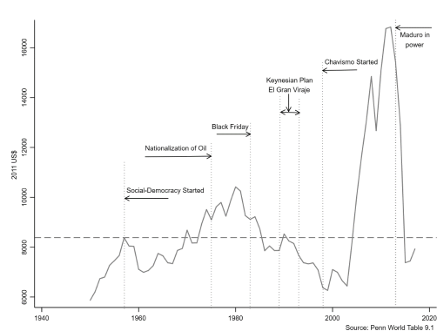
Socialism created another disaster, the value of Venezuelan currency plummeted. Inflation hit, and hyperinflation ensued. Venezuela’s citizens were in danger, their currency was on the verge of destruction, livelihoods changed forever, but they never knew this until it was too late. Seeing figure 1, people can argue that after 1958 Venezuela experienced two great peaks in its GDP per capita, around 1980 and 2011. However, these peaks and “periods of growth”, were promoted by the public sector, and the international market. For example, in the 1970s the Yon Kippur war, following an expansionist policy of the Venezuelan governments buying oil refineries around the world could not explain the big jump during Chavez era, the greatest oil-price boom of recent history. Then, trying to endorse these “growth periods” to those socialist policies in both political projects would not be accurate.
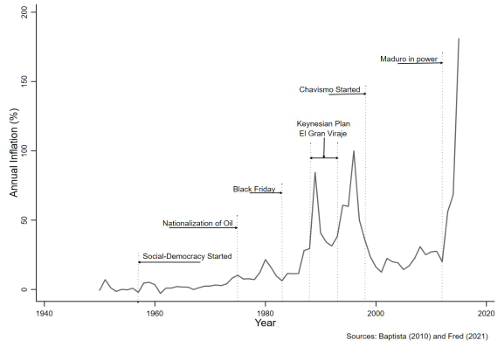
Figure 2 uses data from Baptista (2010) and the Fed of St. Louis. It reports the annual inflation from 1950 to 2016.27 You can observe that this occurred in Venezuela before Chavez. It is just when Maduro took the control of the regime that inflation exceeded the highest value before the Chavismo started.
Figure 2.
Venezuela’s Annual Inflation (from 1950 – 2016)
Typically, all of Venezuela’s recent governments have tried to decrease inflation through price28 and exchange controls (Faria, 2008). Around 90% of the goods and services of the basic consumer basket, considered to measure inflation, have been treated in this manner (Faria, 2008). Exchange controls have been ubiquitous. Here, the government sets an overvalued exchange rate between the Venezuelan currency and the U.S. dollar, and other such currencies. Chavez employed this economically ignorant policy as Martino (2019) explains. Chavez’s regime leaders took advantage of their power and created a black market for a foreign currency to make hefty profits. The socialist regime disregarded the fact that the money stock needed to remain stable for the health of the economy. Instead, they continued to increase the money stock at a ferocious rate. Capital continued to decrease in value due to the social regime’s negligence, but paper money does not attract investors (Lopez-Arce, 2019). Instead of Chavez admitting failure of his reform, the government’s statistics hid inflation from the Venezuelan people (Vincent, 2019).
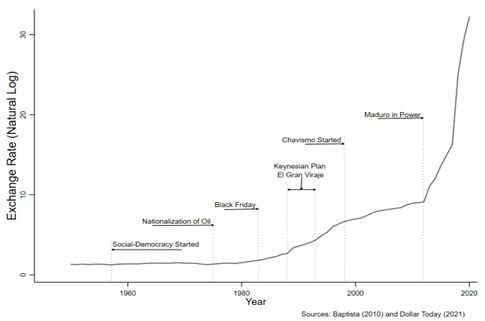
Chavez’s government continued to malpractice aided by the citizens’ ignorance. The precious oil Venezuela produced declined in value and in quantity; what followed was economic and political disarray throughout 2018 (Vincent, 2019). Prices rose at an annualized rate of 160,000% by the end of 2018 (Vincent, 2019)29. Figure 3 shows the historical trend of the exchange rate in Venezuela, for this we used data from Baptista (2010) and Dollar Today (2021), which provides the black-market rate. We had to graph in natural log given the maximum value (December 2020) is 9.99×10¹³ Bs per US Dollar and the minimum value (December 1953) is 3.45 Bs per US Dollar. Mathematical analysis offers some suggestive results on the capacity to devaluate the currency of all governments. For example, from 1950 to 1957 the national currency was strengthened, it did not devaluate but re-valuated by approximately 0.8% annual during 7 consecutive years. When the 4th Republic —or Social Democrat era— started the Bolivar was a very strong currency. Nevertheless, governments started to devaluate by an average of 13% annually for 40 consecutive years. However, the highest devaluation occurred during the Chavez era, or 5th Republic. Since Chavez started to rule the country, the Bolivar has devaluated in approximately 111% annually for 20 consecutive years.
Figure 3.
Exchange Rate Bs per US$ from 1950 to 2020 (values at December)
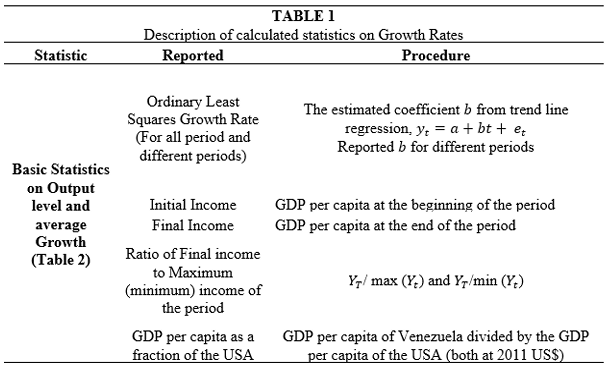
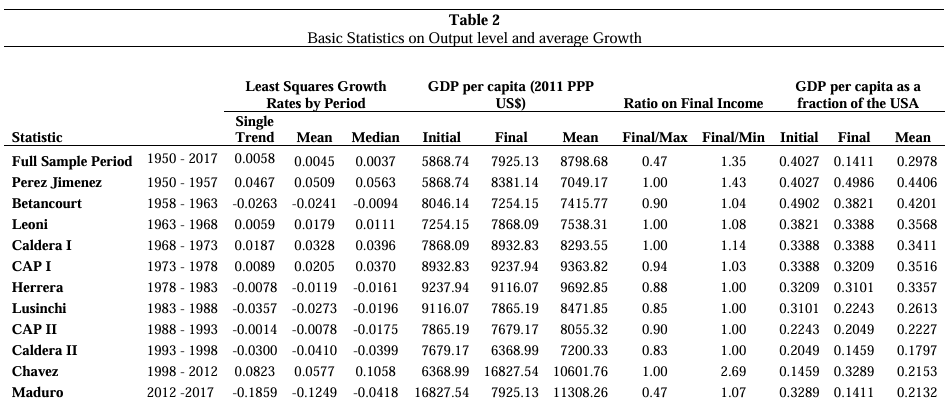
Finally, we present the basic statistics on output level and average growth from 1950 to 2017. We use the Penn World Table 9.1 data, and calculate the reported results as indicated in Table 1. We divide by presidential period and the whole sample.
Source: Own elaboration (2021).
Table 2
Basic Statistics on Output level and average Growth
Source: Own elaboration (2021).
5. Unmasking Chavismo
Chavez’s socialistic beliefs and monopolistic power also radically reduced the freedom of the press. When one structure controls all the power, such as in Socialist Venezuela, the information presented is limited to what the government intends to deliver. The crime of Venezuela’s currency losing value without the citizens knowing about it is an inexcusable case in point.
The Venezuelan people continue to suffer from regulations. Economic freedoms and rights that should be available to all became dissipated, and the nation’s livelihood further deteriorated. According to Acevedo & Cirocco, 2017): «Venezuelans are starving, eating garbage, losing weight. Children are malnourished. Anyone in Venezuela would be happy to eat out of America’s trashcans. It would be considered gourmet». No human should have to suffer from a situation where all they do is survive day by day.30Venezuelans are not poor because they do not work, come up with ideas, or even try. They are impoverished because they are restricted from being independent and their only option is to work for a corporation owned by the government.31
Socialism is very destructive32However, there is still hope for the Venezuelan people. But this requires the end of what Chavez created. In May 2018 President Nicholas Maduro won a fraudulent reelection; in response, other countries in Latin America and the United States and Canada have recognized the speaker of the National Assembly, Juan Guaidó, as Venezuela’s legitimate president. Along with this association, the United States, a significant market for Venezuelan exports, has sanctioned the Maduro regime, frozen its bank accounts, and directed payments by U.S. companies for Venezuelan oil into a new account, which will be made available to Gaudio (Krueger 2019). These actions by the United States are necessary to turn away this nation from its cynical form of government. However, the road ahead is dangerous.
The present administration will not last forever, and Guaidó is still waiting in the wings. Maduro continues to resort to intimidation, imprisonment, and starvation of opposition figures while bribing military leaders for their support (Krueger 2019). This disrespectful behavior can only last for so long. The real question is what this once great nation will do once socialism ends.
An argument counter to the thesis articulated in this essay is that Venezuela’s economic plight is not due to socialism, or to the mismanagement of Maduro and Chavez. Rather, the difficulties stem from the natural resource curse. To be sure, this hypothesis has something to be said in favor of it. After all, Brazil is perhaps one of the most blessed countries on the planet in this regard, and, still, its economy in no way reflects this blessing. On the other hand, Hong Kong and Japan are almost entirely lacking in natural resources, and their economies are relatively prosperous. The same could be said for cities such as London, Paris, New York City. They, too, have healthy economies, totally unrelated to natural resource development.
However, there are also weaknesses in this explanation. Hong Kong and Japan are amongst the jurisdictions closest to laissez faire capitalism, and thus the furthest removed from the devastations of socialism, interventionism, regulationism (Gwartney, 1996). Then, too, there are numerous areas that are almost entirely dependent upon natural resources, and their economies are very far from being “cursed.” For example, Kansas produces wheat, Iowa corn, Texas, oil. Canada, too, is largely based on the development of natural resources, and yet is relatively wealthy.33If there really were such a “curse” it is difficult to see how these areas have escaped from it.
Then, too, there is a theoretical objection to this hypothesis, not merely numerous empirical counterexamples. If it were really true, greater profits in this arena of the economy would be needed to draw in investment, and we see no evidence of that. For example, most investors prefer steady profits to those that vary greatly. The latter require greater returns to attract entrepreneurs. Yes, oil exploration is highly risky, but not so much the management of already proven reserves, which certainly applies to Venezuela.
5. Closing Remarks
Venezuela has many needs; the most important is a free enterprise system (Powell and Acevedo, 2019). This country will need reforms to end rampant inflation, restore macroeconomic stability, and revive economic activity (Krueger 2019). The new leaders must abolish the Venezuelan reforms discussed above, such as government’s power over the press, the steel and the oil industry and many other interventions. New private but businesses should be allowed to form, and old ones restored. The Venezuelan government should allow competition; this would raise its GDP and keep the wolf from the door. Economic freedom would attract entrepreneurs and become part of the Venezuelan culture.34 This system would create, and nurture new ideas and massive amounts of wealth would pour in. Instead of people desperately trying to escape, Venezuela could fully return to its promise and become the first world country it was in the 1950s. However, reconstruction will take great patience, and overall will be a long process. The challenge will be to restore a stable macroeconomic environment and business climate while simultaneously improving the Venezuelan people’s well-being so they will support the political reforms (Krueger, 2019). The task to save Venezuela might seem simple, but as Krueger points out, the Venezuelan people’s political philosophy is most important.35 The people can create change or keep the political party at the end of the day. We can only hope that they have endured enough suffering to know the correct way to conduct business, creating the most opportunity possible. The steps the next leader of Venezuela takes will be crucial in developing and reconstructing this society.
The sad reality is that Venezuela is not the only country that has gone through this sickening process. People in other nations are still going through the adverse effects of socialism to this day. They believe it is nourishing and benefiting them, the destruction of the natural freedoms that pertain to every soul. There tends to be a trend in the direction of socialism even in the U.S.,36and others around the world. All too many people the world over believes that the best way to end poverty is via regulation. These steps to provide the government with control and transfer money away from the wealthy will lead to any nation’s ruination.
This paper is a message to the Venezuelan people to not go down the same forsaken path they had followed but tobe grateful for the power of free market and economic enterprise.
References
Acevedo, R. (2018). “Why Venezuela Is Starving.” October 2: https://mises.org/wire/why-venezuela-starving
_. (2019). The Reforms that Venezuela Needs Right Now. February 1; https://mises.org/power-market/reforms-venezuela-needs-right-now
_. (2021). The Cost of Free Stuff: The Venezuelan Experience. In: The Cost of Free Stuff… Your Freedom. Edited by Rafael Acevedo. Econintech
Acevedo, R., & Cirocco, L. (2017). How Socialism Ruined Venezuela. The Austrian 3, No. 5, 4-7. https://mises.org/library/how-socialism-ruined-venezuela
Acevedo, R., & Cirocco, L. (2020). Venezuela: from Riches to Rags. The real History. In: Prosperity & Liberty: What Venezuela Needs. Edited by Rafael Acevedo. Econintech
Bagus, P. (2011). Will There Be QE3, QE4, QE5…? January 4; http://www.lewrockwell.com/orig10/bagus2.1.1.html
Baird, C. (2000). Unions and Antitrust, The Journal of Labor Research, Fall, pp. 585-600.
Baird, C. (1990). American Union Law: Sources of Conflict, Journal of Labor Research, Summer, pp. 269-292
_____. (2013). American Unionism and Freedom of Association. The Journal of Private Enterprise 28 (2) Spring: 1-21; http://journal.apee.org/index.php/Category:Spring_2013
Baptista, A. (2010). “Bases Cuantitativas de la Economia Venezolana.” Fundacion Polar.
Bello, O., Blyde, J., & Restuccia, D. (2011). Venezuela’s Growth Experience. Latin American Journal of Economics. Vol 48, No. 2: 199-226
Bishop, T. (2018). Are China and the Yuan the Future of Venezuela? May 23; https://mises.org/wire/china-and-yuan-future-venezuela-0
Block, W. (1984). Book review of John Anderson and Morley Gunderson, Union Management Relations in Canada, Don Mills, Ontario: Addison-Wesley Publishers, 1982; in The Journal of Labor Research, Vol. V, No. 1, Winter, pp. 103-105.
_____. (1991). «Labor Relations, Unions and Collective Bargaining: A Political Economic Analysis,» Journal of Social Political and Economic Studies, Vol. 16, No. 4, Winter, pp. 477-507.
_____. (1996A). Labor Market Disputes: A Comment on Albert Rees’ ‘Fairness in Wage Distribution, Journal of Interdisciplinary Economics, Vol. 7, No. 3, pp. 217-230
_____. (1996B). Comment on Richard B. Freeman’s ‘Labor markets and institutions in economic development, International Journal of Social Economics, Vol. 23, No. 1, pp. 6-16
_____. (1999). The Gold Standard: A Critique of Friedman, Mundell, Hayek, Greenspan, Managerial Finance, Vol. 25, No. 5, pp. 15-33.
_____. (2008). Labor Economics from a Free Market Perspective: Employing the Unemployable. London, UK: World Scientific Publishing
_____. (2010). Are unions criminal gangs? Global Virtue Ethics Review, Vol. 6. No. 1, pp. 28-49; http://www.spaef.com/file.php?id=1176
Block, W. & Barnett II, William. (2008). Going (back) to gold money with no government gold: blood in the streets? Indian Journal of Economics & Business, Vol. 7, No. 2, pp. 185 193; http://www.ijeb.com/Year2008_Dec.htm
Boettke, P. (1991). The Austrian Critique and the Demise of Socialism: The Soviet Case, in Austrian Economics: Perspectives on the Past and Prospects for the Future. Vol. 17, Richard M. Ebeling, ed., Hillsdale, MI: Hillsdale College Press, pp. 181-232.
Boettke, P. (1993). Why Perestroika Failed: The Politics and Economics of Socialist Transformation. London: Routledge
Boettke, P. (2001). Calculation and Coordination: Essays on Socialism and Transitional Political Economy. London: Routledge, 2001. http://www.mises.org/etexts/cc.pdf
Bresciani-Turrino, C. (2007). Economics of Inflation: A Study of Currency Depreciation in Post-War Germany. Auburn, AL: Ludwig von Mises Institute.
Brewer-Carias, A. (1983). La Constitucion Venezolana de 1961: Condicionantes Politicos, Evaluacion y Perspectivas. Conference Paper. American Enterprise Institute for Public Policy Research.
Brodie, C. (2017). “Venezuela was once South America’s richest country. Here’s what went wrong.” August 7; https://www.weforum.org/agenda/2017/08/venezuela-economic-woes-2017-explained/
Carrino, I. (2016). “Thousands Flee as Venezuela Implodes.” June 23: https://mises.org/wire/thousands-flee-venezuela-implodes
Cochran, J. (1998). Review of Central Banking in Theory and Practice, Alan S. Blinder, Cambridge and London: The MIT Press, 1998. Quarterly Journal of Austrian Economics, vol.1, no. 4 (winter), pp. 89-92. http://mises.org/journals/qjae/pdf/Qjae45.pdf
Common Sense. (1964). Am I therefore your enemy? Independent Voices, Vol. 48, Issue 8, pp: 1 – 2. https://voices.revealdigital.org/?a=d&d=CMS19640501-01.1.2&e=——-en 20–1–txt-txIN—————1
Cordeiro, J. (2016). La Segunda Muerte de Bolivar… y el renacer de Venezuela. Cedice
DiLorenzo, T. (2016). The Problem with Socialism. Washington, DC: Regnery Publishing
Dorn, J. (1978). Markets True and False in Yugoslavia, Journal of Libertarian Studies, Fall, 2 (3), pp. 243-268.
Dorobat, C. (2015). Viva Venezuela…But Not Yet:https://mises.org/wire/viva-venezuela-not-yet
Evans, J., & Block, W. (2002). Labor Union Policies: Gains or Pains? Cross Cultural Management, Vol. 9, No. 1, pp. 71-79
Ebeling, R. (1993). «Economic Calculation Under Socialism: Ludwig von Mises and His Predecessors,» in Jeffrey Herbener, ed., The Meaning of Ludwig von Mises, Norwell, MA: Kluwer Academic Press. pp. 56-101.
Faría, H. (2007). La Tirania de las Minorias. Revista Conciencia Activa. No. 19: 39-110.
______. (2008). Hugo Chavez Against the Backdrop of Venezuelan Economic and Political History. The Independent Review. Vol XII, No. 4: 519-535.
Faría, H., & Filardo, L. (2015). Venezuela: Without Liberals there is not Liberalism. Econ
Journal Watch. Vol. 12, Issue 3: 375-399.
Faría, H., & Montesinos, H. (2016). “The Critical Role of Economic Freedom in Venezuela’s Predicament.” In James Gwartney et al. ed. Economic Freedom of the World 2016 Annual Report. Fraser Institute
Fetter, F. (1977). Lenin, Keynes and Inflation. Economica, 44, pp. 77-80; https://www.jstor.org/stable/2553552?seq=1
Foss, N. (1995). Information and the Market Economy: A Note on a Common Marxist Fallacy, Review of Austrian Economics, 8(2), pp. 127-136.
Freud, S. (2018). The Ego and the Id. Dover Publications. Originally published in 1927.
Gleason, M. (2019). “Why Powell Fears a Gold Standard.” July 20; https://bit.ly/3q3ejFv
Gordon, D. (1990). Resurrecting Marx: The Analytical Marxists on Freedom, Exploitation, and Justice. New Brunswick, NJ: Transaction.
_______. (2019). “What Venezuela Needs for a Prosperous Future.” December 4; https://mises.org/wire/what-venezuela-needs-prosperous-future
Greaves, B. (1995). How to Return to the Gold Standard. The Freeman: Ideas on Liberty; Vol. 11, November; http://www.fee.org/publications/thefreeman/article.asp?aid=4848
Greenspan, A. (1966). Gold and Economic Freedom. Capitalism: The Unknown Ideal, Ayn Rand, ed., New York: Signet: 1967, pp. 96-101 (reprinted from The Objectivist, 1966); http://www.321gold.com/fed/greenspan/1966.html
Gwartney, J., Lawson, R., & Block, W. (1996). Economic Freedom of the World, 1975-1995; Vancouver, B.C. Canada: the Fraser Institute
Gwartney, J., Hall, J., & Lawson, R. (2010). Economic Freedom of the World; Vancouver, B.C. Canada: the Fraser Institute.
Gwartney, J., Lawson, R., Hall, H., Murphy, R., Berggren, N., McMahon, F., & Nilsson, T. (2020). Economic Freedom of the World; Vancouver, B.C. Canada: the Fraser Institute.
Hazlitt, H. (1965). Back to Gold? The Freeman: Ideas on Liberty, Vol. 15, No. 10, October; http://www.fee.org/publications/the-freeman/article.asp?aid=7670
______. (1980). How to Return to Gold? The Freeman: Ideas on Liberty, Vol. 30, No. 9, September; http://www.fee.org/publications/the-freeman/article.asp?aid=458
Hayek, F. (1935A). Socialist Calculation Debate: The Present State of the Debate In Friedrich A. Hayek (Ed.), Collectivist Economic Planning: Critical Studies on the Possibility of Socialism. London: Routledge and Kegan Paul. 1935. Pp. 201-43.
______. (1935B). The Nature and History of the Debate. In Friedrich A. Hayek (Ed.), Collectivist Economic Planning: Critical Studies on the Possibility of Socialism. London: Routledge and Kegan Paul. 1935. Pp. 1-40.
______. (1940). Socialist Calculation: The Competitive ‘Solution. Economica, Vol. 7 (May): 125-49.
______. (1948). Socialist Calculation I, II, & III, Individualism and Economic Order. Chicago: University of Chicago Press.
Heckel, H. (2020). 11, 1. Britannica Venezuela. Retrieved from britannica.com: https://www.britannica.com/place/Venezuela
Heldman, D. (1977). American Labor Unions: Political Values and Financial Structure, Council on American Affairs, Washington D.C.
Heldman, D., Bennett, J., & Johnson, J. (1981). Deregulating Labor Relations, Fisher Institute, Dallas.
Herbener, J. (2002). After the Age of Inflation: Austrian Proposals for Monetary Reform. The Quarterly Journal of Austrian Economics, Vol. 5, No. 4, Winter: 5-19.
Hoff, J. (1981). Economic Calculation in a Socialist Society. Indianapolis: LibertyPress.
Hong, U. (2000). A Rocky Road to State Reform in Venezuela from 1989 to 1999: Gran Viraje versus Grand Distrust.
Hoppe, H. (1989). A Theory of Socialism and Capitalism. Boston, MA: Kluwer Academic Publishers.
_______. (1991). De-Socialization in a United Germany. Review of Austrian Economics, 5 (2), pp. 77-106.
_______. (1996). Socialism: A Property or Knowledge Problem? Review of Austrian Economics, 9(1), pp. 147-154.
Horwitz, S. (1996). Money, Money Prices, and the Socialist Calculation Debates. Advances in Austrian Economics, Vol. 3, pp. 59-77.
Howden, D. (2008). Stability of Gold Standard and its Selected Consequences: A Comment, Procesos de Mercado: Revista Europea de Economía Política 5(1), 159-175.
Howden, D. (2014). “Venezuela’s Biggest Shortage.” October 8; https://mises.org/wire/venezuelas-biggest-shortage
Shortage.
Huerta de Soto, J. (2006). Money, Bank Credit, and Economic Cycles, translated by Melinda A. Stroup, Chapter 9; Auburn, AL: Ludwig von Mises Institute; http://www.mises.org/books/desoto.pdf
Hülsmann, J. (2008). The Ethics of Money Production Auburn AL: Ludwig von Mises Institute; http://library.mises.org/books/Jorg%20Guido%20Hulsmann/The%20Ethics%20of%20Money%20Production.pdf
Hutt, W. (1973). The Strike Threat System: The Economic Consequences of Collective Bargaining. New Rochelle,
N.Y.: Arlington House; http://www.amazon.com/exec/obidos/tg/detail/-/0870001868/lewrockwell/104-7552446
______. (1989). Trade Unions: The Private Use of Coercive Power. The Review of Austrian Economics, Vol. III, http://www.mises.org/journals/rae/pdf/rae3_1_7.pdf.
Kaza, G. (1996). Is There a Case for the Gold Standard? The Intercollegiate Review. http://www.mmisi.org/ir/32_01/kaza.pdf
Keizer, W. (1987). Two Forgotten Articles by Ludwig von Mises on the Rationality of Socialist Economic Calculation. Review of Austrian Economics, 1, pp. 109-122.
_______. (1997). Schumpeter’s Walrasian Stand in the Socialist Calculation Debate. In Austrian Economics in Debate, edited by Willem Keizer, Bert Riben and Rudy Van Zijp. London: Routledge.
Kirzner, I. (1988). The Economic Calculation Debate: Lessons for Austrians. Review of Austrian Economics, 2, pp. 1-18
Klein, P. (1996). Economic Calculation and the Limits of Organization. Review of Austrian Economics, 9(2), pp 3-28.
Krueger, A. (2019), February 20. How Venezuela can be saved once doomed Maduro falls. Saudi Arabia. https://www.arabnews.com/node/1455436
Lacalle, D. (2017). Venezuela’s Default. November 20; https://mises.org/wire/venezuelas-default-disaster
Lander, L. & Fierro L. (1996). The Impact of Neoliberal Adjustment in Venezuela, 1989. Latin American Perspectives. 23(3): 50-73. doi:10.1177/0094582X9602300304
Lander, L. (2006). A treinta años de la nacionalización el debate continua. Revista Venezolana de Economia y Ciencias Sociales, V. 12, No. 1.
Lavoie, D. (1981). A Critique of the Standard Account of the Socialist Calculation Debate. The Journal of Libertarian Studies, Vol. V, No. 1, Winter, pp. 41-88
Lavoie, D. (1985). Rivalry and Central Planning: The Socialist Calculation Debate Reconsidered. New York: Cambridge University Press
Levendis, J., Block, W. and Eckhardt, R. (2019). Evolutionary psychology, economic freedom, trade and benevolence. Review of Economic Perspectives – Národohospodářský obzor; Vol. 19, No. 2, pp. 73-92.
Lewin, P. (1998). The Firm, Money and Economic Calculation. American Journal of Economics and Sociology, October.
Lopez-Arce, O. (2019). Socialism, Capitalism, and Venezuela’s Oil. Mises Wire. https://mises.org/wire/socialism-capital-and-venezuelas-oil
Martino, D. (2019). How Socialism Destroyed Venezuela. Economics 21. https://economics21.org/how-socialism-destroyed-venezuela
McCaffrey, M. (2014). Venezuela’s Ongoing Economic Crisis. Mises Wire.https://mises.org/wire/venezuelas-ongoing-economic-crisis
McMaken, R. (2016). “What Makes Venezuela Different” June 9; https://mises.org/wire/what-makes-venezuela-different
_______. (2017). “Our Lawless Central Bank». June 22; https://mises.org/library/our-lawless-central-bank
Millard, P., Hoffman, C., Gertz, M., & Jeremy, L. (2019). A Timeline of Venezuela’s Economic Rise and Fall. Bloomberg. https://www.bloomberg.com/graphics/2019-venezuela-key-events/
Mises, L. (1952). Epilogue to The Theory of Money and Credit. «The United States’ Returnn to a Sound Currency.»
______. (1953). The Theory of Money and Credit [originally published in German in 1912]. New Haven, CT: Yale University Press.
______. (1975) Economic Calculation in the Socialist Commonwealth, in Hayek, F.A., ed., Collectivist Economic Planning, Clifton, N.J.: Kelley. Originally published in 1933.
______. (1981A). The Theory of Money and Credit. Indianapolis: LibertyPress/LibertyClassics, ch. 23.
______. (1981B). Socialism: An Economic and Sociological Analysis. Translated by J. Kahane. Indianapolis: Liberty Fund; http://mises.org/books/socialism/contents.aspx. Originally published in 1922.
______. (1981C). Socialism, Indianapolis: LibertyPress/LibertyClassics.
Mueller, A. (2017). “Venezuela’s March Toward Default.” January 4; https://mises.org/wire/venezuelas-march-toward-default
Mundell, R. (1981). Gold Would Serve into the 21st Century. Wall Street Journal, September 30.
Murphy, R. (2008). The Problems of Central Bank Planning. April 4; https://mises.org/library/problems-central-bank-planning
___. (2010). Gold: The Market’s Global Currency. November 11; http://mises.org/daily/4841
_. (2018). Socialism: The Calculation Problem Is Not the Knowledge Problem. March 16; https://mises.org/wire/socialism-calculation-problem-not-knowledge-problem-0
North, G. (1986). Honest Money: Biblical Principles of Money and Banking, chaps 11-13
_______. (2012). How to End the Fed, and How Not To. September 10; http://mises.org/daily/6175/
Osterfeld, D. (1992). Prosperity versus planning: how government stifles economic growth.
New York: Oxford University Press.
Palyi, M. (1972). The Twilight of Gold 1914-1936: Myths and Realities. H. Regnery Co.
Paul, R., & Lehrman, L. (1982). U.S. Gold Commission (September). The Case for Gold: A Minority Report of the U.S. Gold Commission. Washington, DC: Cato Institute.
Paul, R. (1985). The Political and Economic Agenda for a Real Gold Standard,» delivered at the Mises Institute’s 1985 conference on the gold standard; final chapter in The Gold Standard Perspectives in the Austrian http://www.mises.org/books/goldstandard.pdf; http://www.mises.org/story/2826
______. (1988). The Coming World Central Bank. https://mises.org/library/coming-world-central-bank
______. (2009). End the Fed. New York, NY: Grand Central Publishing.
______. (2018). Venezuela’s socialism…and ours. October 3; https://mises.org/power-market/venezuelas-socialismand-ours
Pasour, E. C. (1983). Land-Use Planning: Implications of the Economic Calculation Debate. The Journal of Libertarian Studies, Vol. 7, No. 1, Spring, pp. 127-139
Pérez, C. (1976). La Nacionalización del Petroleo en Venezuela. Revista Comercio Exterior. Mexico http://revistas.bancomext.gob.mx/rce/magazines/367/7/RCE11.pdf
Petro, S. (1957). The Labor Policy of the Free Society. New York: Ronald Press.
Powell, B., & Acevedo, R. (2019). Venezuela Needs a Free Market to Succeed, Not another Socialist Boss. Daily Caller. https://bit.ly/35u6zDe
Rader, R. (1980). Remonetizing Gold, again. The Freeman: Ideas on Liberty. Vol. 30, No. 8, September; http://www.fee.org/publications/the-freeman/article.asp?aid=461
Reisman, G. (1996). Capitalism. Ottawa, Il.: Jameson Books, pp. 951-963
________. (2000). The Goal of Monetary Reform. The Quarterly Journal of Austrian Economics, Vol. 3, No. 3 (Fall): 3–18
Reynolds, M. (1984). Power and Privilege: Labor Unions in America, New York: Manhattan Institute for Policy Research; http://mises.org/document/4962/Power-and-Privilege-Labor-Unions-in-America
_________. (1987). Making America Poorer: The Cost of Labor Law. Washington D.C.: Cato Institute.
_. (1998). The Impossibility of Socialist Economy. The Quarterly Journal of Austrian Economics, Summer, 1.2, pp.29-43.
__. (2009). A History of Labor Unions from Colonial Times to 2009, July 17: http://mises.org/daily/3553
Richman, S. (1981). War Communism to NEP: The Road from Serfdom. The Journal of Libertarian Studies, Vol. V, No. 1, Winter, pp. 89-98
Rockwell, L. (2008). End the Central Bank. November 10; https://mises.org/library/end-central-bank
Rothbard, M. (1962). The Case For a 100 Percent Gold Dollar. Leland Yeager (ed.), In Search of a Monetary Constitution. Cambridge, MA: Harvard University Press, pp. 94. Reprinted as The Case For a 100 Percent Gold Dollar, Washington, DC: Libertarian Review Press, 1974. http://mises.org/rothbard/100percent.pdf
_______. (1963). What Has Government Done to Our Money? Auburn, AL.: Mises Institute; http://www.mises.org/rothbard/rothmoney.pdf
________. (1971). Lange, Mises and Praxeology: The Retreat from Marxism. Toward Liberty. Vol. II, Menlo Park, CA: Institute for Humane Studies, pp. 307 321. Reprinted in The Logic of Action One: Method, Money, and the Austrian School. Glos, UK: Edward Elgar Publishing Ltd., 1997, pp. 384-396.
________. (1975). Gold vs. Fluctuating Fiat Exchange Rates. H. F. Sennholz (ed.), Gold is Money, Westport, CT: Greenwood Press, pp. 24-40. Reprinted in The Logic of Action One: Method, Money, and the Austrian School. Glos, UK: Edward Elgar Publishing Ltd., 1997, pp. 350-363.
________. (1976). Ludwig von Mises and Economic Calculation Under Socialism. Moss, Laurence S., ed., The Economics of Ludwig von Mises, Kansas City: Sheed & Ward, pp. 67-77
________. (1983). The Mystery of Banking. New York: Richardson and Snyder, Dutton.
________. (1984). The Federal Reserve as a Cartelization Device: the Early Years, 1913-1930, in Money in Crisis: the Federal Reserve, the Economy, and Monetary Reform, Barry N. Siegel, ed., Cambridge, MA: Ballinger Publishing, pp. 89-136.
________. (1985). The Case for a Genuine Gold Dollar. L. H. Rockwell, The Gold Standard: An Austrian Perspective. Lexington, MA: D.C. Heath, pp. 1-17. Reprinted in The Logic of Action One: Method, Money, and the Austrian School. Glos, UK: Edward Elgar Publishing Ltd., 1997, pp. 364-383.
________. (1990). Karl Marx: Communist as Religious Eschatologist. The Review of Austrian Economics, Vol. 4, pp. 123-179. Reprinted in The Logic of Action Two: Applications and Criticism from the Austrian School. Glos, UK: Edward Elgar Publishing Ltd., 1997, pp. 331-399.
________. (1991A). The Union Problem.” The Free Market. December 1; http://murrayrothbard.com/The_Union_Problem.html
________. (1991B). The Case for a 100 Percent Gold Dollar. Auburn, AL: The Ludwig von Mises Institute; http://mises.org/rothbard/100percent.pdf
_______. (1991C). The End of Socialism and the Calculation Debate Revisited. The Review of Austrian Economics, Vol. 5, No. 2, pp. 51-76. Reprinted in The Logic of Action One: Method, Money, and the Austrian School. Glos, UK: Edward Elgar Publishing Ltd., 1997, pp. 408-437.
_______. (1992). Aurophobia: or Free Banking on What Standard? A Review of Gold, Greenbacks and the Constitution, by Richard M. Timberlake, Review of Austrian Economics, Vol. 6, No. 1, pp. 97-108; http://www.mises.org/journals/rae/pdf/rae6_1_4.pdf
________. (1993). Man, Economy and State. Auburn AL: Mises Institute.
________. (1995). The Case Against the Fed. Auburn, AL.: Ludwig von Mises Institute.
Salerno, J. (1990). Postscript: Why a Socialist Economy is ‘Impossible’, in Ludwig von Mises, Economic Calculation in the Socialist Commonwealth. Auburn, AL: Ludwig von Mises Institute, pp. 51-71.
_______. (1993). Mises and Hayek Dehomogenized, Review of Austrian Economics, Vol 6, No. 2, pp. 113-146
_______. (1995). A Final Word: Calculation, Knowledge and Appraisement, Review of Austrian Economics, Vol.
9, No. 1, pp. 141-142; http://www.mises.org/journals/rae/pdf/rae9_1_8.pdf
______. (2018). Venezuela Turns to Barter. June 19; https://mises.org/wire/venezuela-turns-barter
Sanín. (1982). Lopez Contreras, de la tiranía a la libertad. 3 ed. Editorial Ateneo de Caracas: Venezuela.
Schmidt, E. (1973). Union Power and the Public Interest. Los Angeles: Nash.
Selgin, G. (2015). Ten Things Every Economist Should Know about the Gold Standard. June 4; https://bit.ly/2Sxy24c
Sennholz, H. (1975A). The Luster of Gold. Westport, Conn.: Greenwood Press
_________. (1975B). Gold is Money. Westport, Connecticut: Greenwood Press.
________. (1979). Age of Inflation. Western Islands; chap. VI.
________. (1985). Money and Freedom. Spring Mills, PA: Libertarian Press, chap. 8
Shea, B. (2010). Solidarity Forever: The power invested in worker collectives under United States. Journal of Libertarian Studies, Vol. 22; pp. 219-246; http://mises.org/journals/jls/22_1/22_1_11.pdf
Schwartzberg, S. (1997). Rómulo Betancourt: From a Communist Anti-Imperialist to a Social Democrat with US Support. Journal of Latin American Studies, 29 (3), pp: 613–65. doi:10.1017/S0022216X9700480X.
Sosa, A. (2001). Romulo Betancourt y el Partido del Pueblo, 1937 – 1941. Edit. Universidad Catolica Andres Bello, Caracas. Venezuela.
Steele, D. (1981). Posing the Problem: The Impossibility of Economic Calculation Under Socialism. The Journal of Libertarian Studies, Vol. V, No. 1, Winter, pp. 7-22; http://www.mises.org/journals/jls/5_1/5_1_2.pdf
_______. (1992). From Marx to Mises: Post Capitalist Society and the Challenge of Economic Calculation. La Salle, IL: Open Court
Syrios, A. (2015). Reflections on Venezuela’s ‘Economic Miracle’. October 23; https://mises.org/library/reflections-venezuelas-economic-miracle
Tablante, L. (2006). La pobreza como tema político y mediático en Venezuela. Cahiers des Amériques latines. http://journals.openedition.org/cal/1731.
Tintori, L. (2019) January 26. How we save Venezuela. The Washington Post: https://www.washingtonpost.com/news/theworldpost/wp/2019/01/26/venezuela/
University of Pennsylvania. (2016). How Venezuela Fell Apart. Public Policy series. Knowledge Wharton. Retrieved:
March 10, https://knowledge.wharton.upenn.edu/article/how-venezuela-fell-apart/
Utt, J. (1965). The Lynch Trial of Marcos Perez Jimenez. In Extension of Remarks. Congressional Record Appendix. A4906 – A4908, pp. 10-12. Approved for Release 2003/10/14. US Congress. RDP67B00446R000300130001-4.pdf https://www.cia.gov/readingroom/docs/CIA
Vieira, E. (2002). Pieces of Eight. 2 ed. Fredericksburg, VA: Sheridan
Vincent, T. (2019). Venezuela: Posterchild for Socialism. https://mises.org/wire/venezuela-poster-child-socialism
Weyl, N. (1960). Red Star Over Cuba. Publisher: Devin-Adair. Mises Wire.
Wiegold, B. (2014). Socialism and Other Crimes in Venezuela. November 5; https://mises.org/library/socialism-and-other-crimes-venezuela
World Population Review. (2020). World Population Review. Retrieved from https://worldpopulationreview.com/country-rankings/democratic-socialist-countries
- We thank two very active and thorough referees for helping us greatly improve this paper. Of course, the
usual caveat applies: any remaining errors of substance or infelicities are solely the responsibility of the
present authors. There is only so much, after all, that good referees can do. ↩︎ - In 1975, Venezuela had a score of 6.9 out of 10 in terms of economic freedom. This declined to 6.6 in 1980,
to 5.2 in 1985, boosted to 5.5 in 1990, continued its downward trend to 4.5 in 1995 (Gwartney, 1996.) Its
subsequent scores were 2000: 5.61; 2005: 4.72; 2007: 4.35; 2008: 4.33 (Gwartney, 2010); 2010: 3.79; 2015:
2.84; 2014: 3.34 (Gwartney, 2020) ↩︎ - This was only the tip of the iceberg. Economic freedom ranged widely over the entire economy. See on this
Acevedo, 2018, 2019; Bishop, 2018; Carrino, 2016; Dorobat, 2015; Gordon, 2019; Howden, 2014; Lacalle, 2017; McCaffrey, 2014; McMaken, 2016; Mueller, 2017; Paul, 2018; Salerno, 2018; Syrios, 2015; Wiegold,
2014 ↩︎ - According to that old aphorism, if a man of 20 is not a socialist, he has no heart; if he is still one at 50, he
has no brain. ↩︎ - For a critique of socialism, see Boettke, 1991, 1993, 2001; DiLorenzo, 2016; Dorn, 1978; Ebeling, 1993;
Foss, 1995; Gordon, 1990; Hayek, 1935a, 1935b, 1940, 1948; Hoff, 1981; Hoppe, 1989, 1991, 1996; Horwitz,
1996; Keizer, 1987, 1997; Kirzner, 1988; Klein, 1996; Lavoie, 1981, 1985; Lewin, 1998; Mises, 1975, 1981;
Murphy, 2018; Osterfeld, 1992; Pasour, 1983; Reynolds, 1998; Richman, 1981; Rothbard, 1971, 1976, 1990,
1991; Salerno, 1990, 1993, 1995; Steele, 1981, 1992. ↩︎ - 6For the case in behalf of gold as money, see Block, 1999; Block and Barnett, 2008; De Soto, 2006; Gleason,
2019; Greaves, 1995; Greenspan, 1966; Hazlitt, 1965, 1980; Herbener, 2002; Howden, 2008; Hulsmann,
2008; Kaza, 1996; Mises, 1952, 1981; Mundell, 1981; Murphy, 2010; North, 1986; Palyi, 1972; Paul, 1985;
Paul and Lehrman, 1982; Rader, 1980; Reisman, 1996, 2000; Rothbard, 1962, 1963, 1975, 1983, 1985, 1991,
1992; Selgin, 2015; Sennholz, 1975A, 1975B, 1979, 1985; Vieira, 2002 ↩︎ - We state “pseudo-military” because General Gomez was the president who modernized Venezuela’s army.
Before him, there was just guerillas, and a complete mess with men in arms revolting the country. However,
General Gomez was in one of those pseudo-military statements headed by General Cipriano Castro, his
personal and close friend, that he betrayed and overthrew in another coup d’etat. ↩︎ - This is a description of actual events. We do not buy into the notion that industrialization is somehow more
productive than agriculture. Iowa, Kansas, Nebraska, are almost entire farm country, and they are hardly
poverty stricken. ↩︎ - But see ibid ↩︎
- For the argument that economic growth obtains despite labor unions, not because of them, see Baird, 1990,
2000, 2013; Block, 1984, 1991, 1996A, 1996B, 2008, 2010; Evans and Block, 2002; Heldman, 1977;
Heldman, Bennett and Johnson, 1981; Hutt, 1973, 1989; Petro, 1957; Reynolds, 1984, 1987, 2009; Rothbard,
1993, n.d.; Schmidt, 1973; Shea, 2010. ↩︎ - For a general critique of central banking, see Cochran, 1998; Hülsmann, 2008; McMaken, 2017; Murphy,
2008; North, 2012; Paul, Ron. 1988, 2009; Rockwell, 2008; Rothbard, 1983, 1984, 1995 ↩︎ - An important difference between Perez Jimenez’s housing projects and that of the governments after him
is that he required that families pay a symbolic amount, with subsidized price, interests, and no down payment,
and they obtained the full property rights on infrastructure and land. Governments after he managed their
housing projects just like a transfer, zero monetary cost, but families did never have the full rights of the
properties or of the land. ↩︎ - This refers to Venezuelan families well connected with politicians started to influence policies to obtain
benefits and create wealth…. ↩︎ - See Brewer-Carias, 1983. ↩︎
- Socialists have always marketed Betancourt as the person who gave democracy to Venezuela in an attempt
to erase his communist roots. Nevertheless, people supporting this forgot that there is strong historical
evidence to the effect that “democracy started with Lopez Contreras and not with Adecos” (Sanin, 1982). ↩︎ - The 26th of July Movement was the Cuban organization led by Fidel Castro. ↩︎
- This partnership was also reported by the newspaper Common Sense (1964) “JFK had a friendly meeting
with Romulo Betancourt, the President of Venezuela, who was Castro’s partner in starting a riot in Bogota,
Colombia” (p. 2) ↩︎ - In the USA sense, meaning socialists. ↩︎
- The present authors thank the anonymous referee who encouraged us to research more deeply and supply
evidence in support of the argument that Betancourt was really a communist who conveniently changed and
became a democratic socialist while still applying his own brand of communism. ↩︎ - The most common point in both pacification deals was the agreement to allow these people to enter the
political arena and be forgiven for their previous criminal acts. ↩︎ - Indeed, the compensation was more than 4,300,000,000.00 bolivars, when the nationalization was
undertaken by Perez’s administration. Venezuela had a fixed exchange rate of 4.30 bolivars to each US$. In
addition, oil experts calculated that that compensation was more than double of profits after taxes that
enterprises could obtain if the nationalization would have happened in 1983, when the law mandated (Lander,
2006). ↩︎ - In English would be “The great change.” because they were promoting that Venezuela would change from
a paternalist State with a high intervened economy to a more individualistic and free economy. ↩︎ - Dr. Ricardo Hausmann, current Director of the CID in Harvard was the second in charge of the economic
team just after Dr. Miguel Rodriguez Fandeo, other renowned radical Keynesian economist with studies in
Harvard and Yale. ↩︎ - The World Bank reports that in 1998 the total External Debt was around 49.473 Billion US$ and when
Chavez passed away, 2013, the external debt reached 153.89 Billion US$, approximately 211% of increment. ↩︎ - Well, it was not exactly outright theft. A veneer of legality was placed on this “transaction.” But in a real
sense that does not make this any less of a robbery. ↩︎ - When we state “sustainable growth” is because the trend of the economic growth does not show deep falls,
such as those you can observe during the “Social-democrat” era. In addition, it did not depend exclusively on
an oil-price boom such as that increment in the GDP per capita observed between 2003 and 2012. ↩︎ - We had to leave out of this graph the values for 2017 to 2020 because some of them overpassed the 60,000%
and this does not allow performing a visual comparison. We did not feel comfortable placing this on a
logarythmic axis, since our source did not. ↩︎ - Venezuela is by no means alone in committing this economic error. The WIN policy in the US (Whip
Inflation Now!) is a case in point. See on this: https://www.youtube.com/watch?v=JULw8qsnHcY ↩︎ - There is perhaps no better way to ruin an economy than to debauch its currency. This is the view of Lenin
(Fetter, 1977.). On the evils of inflation see Bagus, 2011; Bresciani-Turrino, 2007; Herbener, 2002;
Huelsmann, 2008; Mises, 1953; Rothbard, 1990 ↩︎ - And all too often do not reach that goal. ↩︎
- Happily, there is one safety valve: emigration out of Venezuela. But this is a heavy indictment of the policies
pursued in that country. See on this:
https://www.google.com/search?q=emigration+from+venezuela&rlz=1C1CHBD_enUS790US790&oq=emi
gration+from+Ven&aqs=chrome.0.0j69i57j0i10i22i30j0i22i30.5088j1j15&sourceid=chrome&ie=UTF-8;
https://www.worldbank.org/en/news/feature/2019/11/26/migracion-venezolana-4500-kilometros-entre-el
abandono-y-la-oportunidad ↩︎ - Perhaps the best illustration of this, both of them almost controlled experiments, are the diverging
experiences between North and South Korean, East and West Germany. ↩︎ - Sometimes Canadians are referred to as “hewers of wood and drawers of water.” This is somewhat of an
exaggeration, only somewhat. See on this claim:
https://www.google.com/search?q=Canadians+are+referred+to+as+%E2%80%9Chewers+of+wood+and+dr
awers+of+water.%E2%80%9D&rlz=1C1CHBD_enUS790US790&oq=Canadians+are+referred+to+as+%E
2%80%9Chewers+of+wood+and+drawers+of+water.%E2%80%9D+&aqs=chrome..69i57.2598j0j15&sour
ceid=chrome&ie=UTF-8 ↩︎ - This is the system that worked for the five Asian tigers (Hong Kong, Japan, Korea, Singapore and Taiwan).
They adopted capitalism and prospered. There is no geographical limitation to free markets. There is no
reason this system cannot also function in South America. ↩︎ - The pen is mightier than the sword. The former determines the direction in which the latter is pointed. ↩︎
- There are ominous parallels in the US, what with wokeism, political correctness, trigger warnings, safe
spaces, racism, critical race theory, systemic racism, intersectionality, Black Lives Matter, the knockout game,
the cancel culture, feminism, and all the rest. Things are by no means as bad in the country in North America
as in South America, but the precedents in the former are not comforting. Then, when we add in more
regulation, higher taxes, “equity,” left takeover of academia, journalism, and, yes, even business the case for
the US following the Venezuelan example become even more likely. ↩︎
* Christian Hanson is a student of Business Analytics at Loyola University New Orleans. E-mail: chhanson@my.loyno.edu
Y Walter E. Block holds a Ph.D. in economics (Columbia University). He currently holds the Harold E. Wirth Eminent Scholar Endowed Chair at Loyola University New Orleans. E-mail: wblock@loyno.edu
f Rafael Acevedo is Research Associate in the Free Market Institute at Texas Tech University. Founder-Director and CEO of Econintech. Corresponding author: rafael.acevedo@ttu.edu