Socher, K., & Chávez, D. (2021). The Legacy of Karl Socher: Applications and Perspectives of the Austrian School of Economics. Estudios Libertarios, Vol. 4, 107-117.
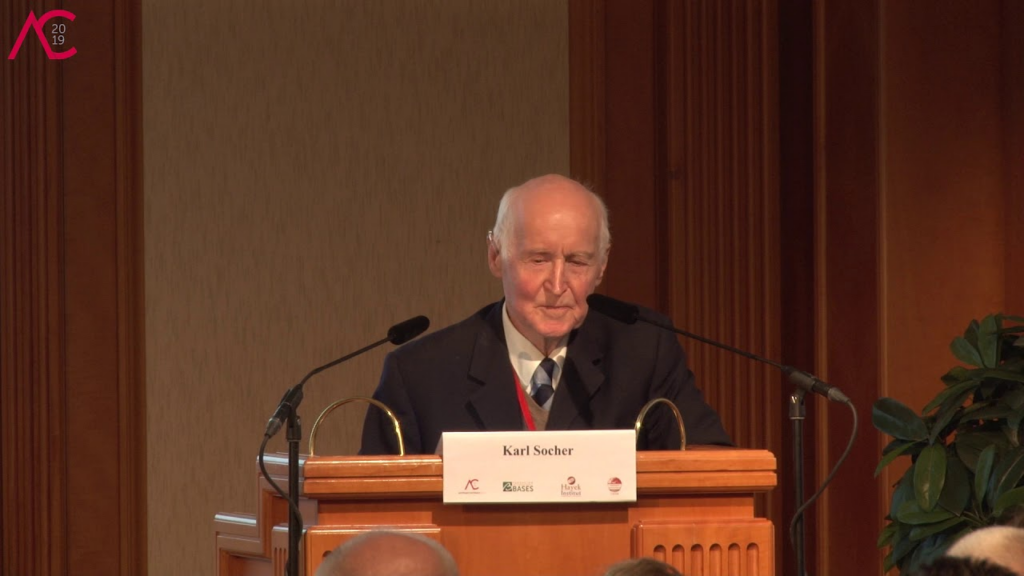
KARL SOCHER* & DAVID CHÁVEZ SALAZARY
Resumen
Este trabajo tiene el objetivo de presentar la figura del economista austriaco (tanto de Escuela como de nacionalidad) Karl Socher a la audiencia austrolibertaria de Estados Unidos, España e Iberoamérica. Se ha empleado la metodología de la “entrevista semiestructurada”, una técnica usada en investigación cualitativa en la que el investigador prepara un guion temático sobre las materias a abordar, las preguntas son abiertas y el entrevistado puede expresar libremente sus opiniones, matizar las respuestas e incluso traer a la discusión nuevos temas.
Es importante conocer la obra de K. Soccer por varias razones. En primer lugar, por su laboriosidad y originalidad intelectual; en sus más de 200 publicaciones (que incluyen artículos científicos, artículos de opinión, documentos de política, capítulos de libro y libros) ha sido capaz de expandir la frontera del conocimiento de la Escuela Austriaca, dejando un legado que merece ser estudiado por los simpatizantes de esta corriente del pensamiento económico por fuera de Austria.
La segunda razón es su valor histórico. El profesor Socher ha sido testigo directo del desarrollo de la Escuela Austriaca por lo menos durante las últimas siete décadas. De hecho, se formó bajo la influencia de varios de los grandes economistas de la tercera y cuarta generaciones de la Escuela Austriaca, como lo son Hans Mayer y Gottfried Haberler. Por otra parte, K. Socher no hizo parte del éxodo de economistas austriacos a Estados Unidos, por lo cual puede darnos una visión del transcurso que ha tenido la ÖSchule en su país de origen. Sin embargo, su mirada también es hacia el futuro, específicamente, hacia los desafíos intelectuales que enfrenta la Escuela Austriaca en el siglo XXI.
En particular, el diálogo con el profesor Socher giró en torno a los siguientes ejes: su vida y obra, la Escuela Austriaca de Economía, temas de política monetaria y política fiscal, gestión cultural, turismo, algunos temas económicos y sociales de Europa, e instituciones financieras internacionales.
Palabras clave: Escuela Austriaca; Karl Socher; Política Monetaria; Política Fiscal; Europa; Instituciones Internacionales.
Clasificación JEL: B53;B31; E52; E62; N24; F55.
This interview was conducted by David Chávez Salazar originally in German and later translated into English. The original title is: “Das Erbe Karl Sochers: Anwendungen und Perspektiven der Österreichische Schule der Nationalökonomie”.
- Introduction
Karl Socher is Professor Emeritus at the University of Innsbruck. In his long academic and professional career, he has held important positions in both public and private institutions. In the academic field, he was Dean of the Faculty of Economic and Social Sciences at the University of Innsbruck, founder of the university tourism course of the same faculty, and visiting professor at several universities around the world, such as the prestigious University of Strasbourg.
He has also served as chairman of the Budgetary Policy Working Group of the Advisory Council for Economic and Social Affairs, the Economic Policy Council of the ÖVP, the Advisory Council of the Austrian Federal Ministry of Finance, the Advisory Council of the Institute for Transport and Tourism, and the Advisory Council of the Research Institute of the Innsbruck Savings Bank, among others. He is also a member of the American Economic Association, Verein für Socialpolitik (On the monetary theory committee), Mont Pelerin Society, AIEST, Tourism Research Center, Internationales Institut “Österreichische Schule der Nationalökonomie”, Hayek-Institut, and Europa-Union Tirol.
His teaching and research have revolved around the areas of monetary theory and policy, business cycle theory and policy, banking and financial market supervision, tourism economics, economic policy theory, and cultural economics.
2. Dialogue
David: Professor Socher, it is a great honor to be able to talk with you. In our journal we consider that beyond theory, in the academy it is also important to know the person. There is always a story behind every great thinker, for that reason, please tell us about your life, your career and how you approached the ideas of the Austrian School of Economics.
Prof. Karl Socher: I was born in Berlin in 1928 as the son of Austrian parents. My youth was then under the impression of National Socialism and its war. I experienced the dictatorship and wartime economy, which was only slowly relaxed again after the war. I then realized that economic policy needed more freedom and less government planning and inflation. The basis for the principles of the Austrian School was laid in my youth, but I only got to know them during my studies.
My father was an opponent of the National Socialists and fled to London after the occupation of Austria in 1938 because otherwise he would have become a German citizen and would have been at the mercy of National Socialism. As early as 1936 he predicted to me that Hitler would soon go to war and lose it.
My parents sent me to schools that were not National Socialist, e.g., Salem, which an English teacher had founded because he accused German schools of glorifying war and the military and therefore preaching obedience instead of freedom and personal responsibility.
At the age of 15, I was drafted into the anti-aircraft battery. We shot down 7 American bombers. After graduating from high school in 1947, I wanted to study economics, which I hadn’t heard about in high school, but later in a business school.
I wanted to learn how Austria can do away with the war and post-war economic policy and inflation and achieve a freer market economy again. However, I also envisaged «social» measures, e.g., for pensioners.
In Austria you could not «study” economics, all the famous Austrian economists studied law, where a lot of economics, economic and fiscal policy was taught, so that the graduates could not only become judges and lawyers, but also civil servants, e.g., in ministries.
But I did not want to learn the existing law, but how to improve the existing law. That is why I studied government science from 1948-1953, with a focus on economics. The professor for this was Hans Mayer, a representative of Austrian economics. As a dissertation, he suggested that I should investigate whether the monetary theory of Wieser, who had tried to explain the monetary theory with the Austrian Economics. But I did not succeed, I only came to the conclusion that Wieser’s theory is contradictory, but that Ludwig von Mises provided starting points for an Austrian monetary theory. It was a big mistake on my part not to develop these approaches further.
During my studies, Keynesian teachings spread. All younger economists adopted this modern economics. Hans Mayer tried to criticize it, but did not go into the principles enough… When I then joined an economic research institute after my doctorate as a consultant for currency, money and capital markets, the people there had great misgivings about me because I did not represent Keynesian teachings.
But also in the economic research institute, as in the following jobs, I was often able to fall back on the Austrian school, e.g., in the institute that used to be the business cycle research institute founded by Mises and headed by Hayek, on the Austrian business cycle theory.
Gottfried Haberler often visited the institute, and he got me a scholarship to study at Harvard University in 1957/8, where I was able to expand my knowledge of his Austrian teaching on foreign trade and economics.
From 1960 to 1964 I worked at the Deutsche Bundesbank, where monetarism determined monetary policy. In 1964 the Austrian Minister of Finance wanted to bring an economist into the ministry because there was not one in it. I worked there until 1970 and was then able to write my habilitation (to be compared with a PhD) in the chamber of commerce in 2 years, with which I was appointed professor for political economy in Innsbruck in 1973. In my habilitation, I criticized the too close relationship between financial and monetary policy, in accordance with the idea of the Austrian School.
David: We know that after World War II, several of the most important economists of the Austrian School emigrated to the United States. Even there they trained new generations of great thinkers. However, not all of them left Austria. What is the relevance of the Austrian School in Austria today?
KS: Unfortunately, I have to say that the Austrian School is practically no longer represented at the universities. When I was active (until 1996, retirement) there were two more colleagues; Erich Streissler and Werner Clement, active. Sometime around 1980, the Austrian School was announced and promoted by two finance ministers (in Austria they are also economy ministers). For about 10 years, journalists have represented the Austrian School in the discussion of current economic policy in the newspaper “Die Presse”. For a few years there have been think-tanks (Aggenda Austria and Hayek Institute) that also publish research on the fundamentals of Austrian economic policy from the point of view of the Austrian School. The Hayek Institute also represents the Austrian School with internationally recognized activities.
David: In your opinion, what are the biggest challenges for the Austrian School of Economics in the 21st century?
KS: It should be known at the universities, not necessarily as the only teaching, but also in comparison with other teachings. In the political discussion about today’s great challenges, it should take part more than before, as think-tanks without party political ties in particular can do. For example, the cause of the current inflation has only recently come to the explanation of the Austrian School.
David: This is a matter of epistemology. Why should the Austrian School of Economics advocate value-free economics? And What would be the responsibility of the scientist in dealing with the ethical consequences of economic activity?
KS: In today’s universities, the Austrian School of Economics is sometimes presented as an ideology, for example by Marxists. Marxist claims and forecasts cannot be scientifically substantiated, like most AE claims, mostly through empirical evidence, e.g., better consumer sourcing, innovations through market competition and private property, as in India and even China with their high growth rates. against the socialist countries.
David: Now let us talk about the applications of the Austrian School of Economic. A very important one is related to monetary theory, in that sense, I would like to ask you: What is your opinion on the European Monetary Union?
KS: An analysis of monetary unions of the past, made in Innsbruck (Theresia Theurl), has shown that all have broken up again, unless their members have become a state. The European Monetary Union is not an optimal union because the members are so different that a central monetary policy cannot address national differences. It is also not sufficiently protected against government debt policies, but is currently pursuing a zero-interest policy, contrary to its statute, which causes inflation. A national monetary policy and flexible exchange rates would be the better solution.
David: For many analysts, the eurozone is going through a terminal crisis. How could a free-banking system work in the Eurozone? That is, without the existence of a central bank, without legal tender, and with the presence of many banks competing to issue money.
KS: There is much to be said for Hayek’s proposal, but even Hayek points out a problem: having multiple currencies in a country makes payments and accounting difficult and costly. A most stable currency resulting from competition would acquire a monopoly that could inflate and be difficult to eliminate through competition. Hayek once said that a European monetary union could only work if it was based on gold. But a gold currency could no longer work with today’s low wage and price flexibility.
David: Another topic that has been studied a lot within the Austrian School is the tax issue. In an ideal world there would be no taxes as they are nothing more than the confiscation of wealth. But until we reach that ideal world, what reforms could be made to tax systems in favor of economic growth and freedom?
KS: A completely free market economy cannot function because not all decisions necessary for economic activity can be made by the market economy. There are ‘public goods’, ‘externalities’, which today are incorrectly called ‘market failures’. The market does not fail, but it cannot solve problems such as CO2, overfishing, national defense and so on. Austrian economists like Hayek see it too. However, the state should only be used where the market does not allow it, and the measures should also be designed in a market-economy manner as far as possible. In a democracy, progressive taxation cannot be avoided, no matter how good Hayek’s arguments against it are. Hayek is therefore also critical of democracy.
David: If you allow me, we can relate the two topics that we have previously addressed. Therefore, my question is: What are the fiscal bases of the prevailing monetary system?
KS: The prevailing monetary system is far too little protected against fiscal influence. The task of the monetary system is to create stable money so that the market economy can function efficiently. The present fiscal influence leads however to economic fluctuations and inflation, as the Austrian School has stressed for a long time The money creation should not take place by state credit, the state and the central bank should be forbidden the borrowing with the central bank and money-creating banks. It is to finance itself private savers and investors.
David: You have not only addressed the classic themes of the Austrian School, but you have also addressed issues that are not usually studied in Austrian literature, including cultural issues. In this regard, I would like to ask: In your opinion, what role could the state play in cultural management in a market economy context?
KS: None. The state mostly uses the tax money for the art that its political officials consider good: Example of National Socialist and Soviet art policy. At best, monument protection and museums can be viewed as «public goods» because they cannot be adequately provided by the market.
David: Another very original theme in your work is tourism. How have you related tourism to international trade and economic theory in general?
KS: The same applies to tourism as to other economic sectors that emerged much earlier. The special conditions in tourism have not been studied enough.
It also applies to tourism that through free competition a country can specialize in tourism, which brings it high added value. In contrast to trade, the customer comes to the country of supply, just as in trade, the transport costs also play a role, but in tourism, travel and its costs are a factor that also creates benefits for the traveler. Similar to luxury goods, tourism demand is almost zero at low-income levels, but then very elastic and only less elastic again at high-income levels. Domestic tourism begins with low income, then the more expensive tourism abroad arises. Once tourism has reached a higher level, it becomes a habit and thus hardly decreases when income falls. In the case of foreign tourism, when the price level changes in a country or when the exchange rate changes, it can be observed that the demand reacts much more quickly than in the case of commercial products. The competition is less between countries and more about the destination of tourism activity, e.g., sea, mountains, cities.
In tourism, the production factors for the offer are above all work, less capital, but also the non-produced environment, such as landscape, sea, mountains, castles, palaces, old towns, culture. The request for these goods sometimes costs little or nothing.
Because labor costs are so important, in high-income countries with higher wages and lower capital costs, the supply costs more and is fueled by capital-intensive tourism, such as apartment or self-service. However, only about half of the offer is due to the accommodation and subsistence costs, but a significant part to transport costs.
Tourism as a service sector can generally achieve fewer increases in productivity through innovations than industry. As a result, wages in tourism could rise less than in industry. However, this is not possible in the long term, which is why wages in tourism must rise at about the same rate as in industry, so that tourism prices rise more sharply than in industry. In several tourism countries in Europe this has been prevented by the large immigration, because the immigrants find it easier to find work in tourism because they don’t have to have great qualifications and know the language, so they are ready, even with low wages and bad working conditions, e.g., weekends. The wages are still higher than in the country of origin. However, this means that the working conditions are no longer attractive for nationals.
A major problem for tourism policy today is the excessive number of tourists and the associated pollution of the environment: «Too much tourism destroys tourism». Should the state take action? Ludwig von Mises has already shown that if the prerequisites for a market economy exist (private property, prices), for example a beautiful alpine valley whose access can be priced and which can also be used for a water dam to generate electricity (and thus destroys the beauty), the owner can decide which use will bring the greater benefit to the economy as a whole. However, the prerequisites for this market-based solution are not available everywhere. In particular, the sight of a beautiful landscape, a castle, a fortress or, for example, a geyser cannot be assigned a price. This means that the view is a “public good” and the state is therefore responsible. For example, it can introduce nature conservation, such as a geyser in the USA that was protected from being built up for the first time. The same applies to monument protection and national parks.
In Tyrol, ski lifts to and on glaciers were banned, and ski slops were limited. Today also to save CO2.
“Public goods” also exist in health resorts. It is more efficient to use the spring through a joint spa house than through a monopoly or competition between individual hotels. Likewise, a spa park, a spa concert and, above all, the walks for tourists can hardly be financed by prices. That is why there has long been a «spa tax» that is paid by the tourists who stay overnight in the village and that is used for the free offer.
Likewise, for the first time in Tyrol, a tourism tax has been enforced for all local businesses that benefit from tourism, e.g., souvenir shops, bakeries, mountain railways, even doctors and pharmacies. If an individual hotelier advertises his hotel, he must also advertise the location. This creates an «external effect» for the other hotels and companies, who benefit from it free of charge. Advertising can then be operated much more professionally and worldwide. But there are many problems with this state tax, for that reason I recommended private-publics partnerships for advertising.
David: Since we are talking about international flows. From your point of view, what perspective does the Austrian School of Economics have on international institutions such as the IMF or the World Bank?
KS: The Austrian Economics is often more important to economists in international institutions than it is in individual countries. At the WTO, free trade is the goal, at the IMF the fixed rate system with the dollar was a basis, but under the influence of Austrian economists like Haberler, the flexible exchange rate system and freer capital movements were then accepted. The World Bank originally gave its loans to governments and later also for private projects. It focuses more and more on promoting growth as a basis for poverty reduction. Speaking at the earlier annual Böhm-Bawerk Seminar, a World Bank vice president said they realized that the best growth policy is greater economic freedom, but the biggest obstacle is government policies of corruption, nationalization, and restraints on liberties, which the World Bank opposes very difficult to arrive.
David: I would like to close with another question about international flows, this time of people, I mean migration. In recent years, Europe has experienced an unprecedented crisis due to the arrival of thousands of refugees. In your opinion, how could the European refugee crisis be solved?
KS: Free immigration might be liberal. But it would lead to the countries that have achieved a high income through good economic policy and then suffer strong wage pressure and exploitation of the social system through immigration. Therefore, there must be a limit, such as that introduced by the immigration country USA at the end of the 19th century, when California shipped thousands of Chinese coolies through shipping companies, so that immigration from eastern USA stopped. Since then, there have been restrictions on immigration, otherwise California would be a Chinese province today.
The EU must also limit immigration and leave it up to individual countries to do so. This must result in the abandonment of free migration in the EU, otherwise allowing immigration into a country would lead to migration from that country to the richer member countries. International agreements on refugee immigration must be limited. The EU cannot take in all refugees from war-torn countries.
3. Some works of Karl Socher
The vast majority of Professor Karl Socher’s work is written in German. For that reason, in this section, I will make a selection of the works written in English. Likewise, those who wish to know the complete list of his works can go to this link:
https://www.uibk.ac.at/economics/personal/socher/index.html.de
And search for «Publikationen».
Works in English (Short List).
On the Way to the European Currency Union – A Comment, in: J. Chen u. Chr. Smekal (Hrsg.), Economic Effects of Regional Integration in Europe and North America, Veröffentlichungen der Universität Innsbruck, Band 200, 1994, S. 129-130.
Monetary Policy in Austria, in: Monetary Policy in Industrialized Countries, Sammelband der Federal Reserve Bank of Boston, herausgegeben von K. Holbik, Boston 1973, S. 1-38.
Political Economy of the Relation between Austria and Germany. In: Proceedings of the Fourth Conference of the University of Innsbruck and National Taipei University: “Competition or Cooperation? Sept. 18, 2004, National Taipei University, Taipei, Republic of China”
International Institutions seen from the viewpoint of Austrian Economics. In: Progress in Development Studies, volume 9, issue 4, October 2009, Special issue: International Institutions, Twenty First Century Challenge, Pages 311 -321
Globalization and International Monetary and Capital Markets. In: John-Ren Chen (Ed.) Economic Effects of Globalization, (Smekal Festschrift), Ashgate 1998, p.31-43
With Harald Pechlaner: Public Policies for Cultural Heritage within the Destination. Special Report, 49th Congress 1999, in P. Keller, Th. Bieger (Editors): Future-Oriented Tourism Policy – a Contribution to the Strategic Development of Places, AIEST, vol. 41, St.Gallen, 1999, S. 271 – 282
Tourism in the theory of international trade and payments, Revue de Tourisme, Bern-St. Gallen 1986, No. 3, S 24-26.
Tourism Policy Problems of a Transforming and Developing Country – Impact of Globalization on Tourism in Mongolia. Special Report for AIEST-Conference Globalization and Tourism, Rotorua, New Zealand, 1996 (not published).
Additionally, you can also consult one of the latest presentations by Dr. Socher «The future of the EU seen from the perspective of the Austrian School of Economics» (2019):
* Karl Socher is Professor Emeritus at Institut für Wirtschaftstheorie, Wirtschaftspolitik und Wirtschaftsgeschichtegeschichte der Universität Innsbruck (University of Innsbruck).
Y David Chávez Salazar is the CEO of Libertas Phyle and editor-in-chief of this journal.