Estudios Libertarios. Vol. 1 (2018).

WALTER E. BLOCK & GABRIEL PHILBOIS*
I. Introduction
In the view of Barzel and McDonald (1973): “The backward bending supply curve of labor (BBSCL) is now accepted as a matter of course by most economists.” They are undoubtedly correct in this claim of theirs.1
Something of the same degree of consensus amongst dismal scientists exists with regard to the Giffen Good (GG). In their view, this concept too, is a valid one, at least theoretically, putting to the side the issue of whether or not there are any real-world examples of this phenomenon.2
The present paper rejects both the BBSCL and the GG. We do so on two grounds. Supply and demand irrationality (section II) and internal inconsistency; of the former (section III) and the latter (section IV). In section V we reconcile the individual BBSCL with the market supply of labor, which is upward sloping. We consider a complication in section VI and conclude in section VII.
II. Research Methodology
III. Supply and demand
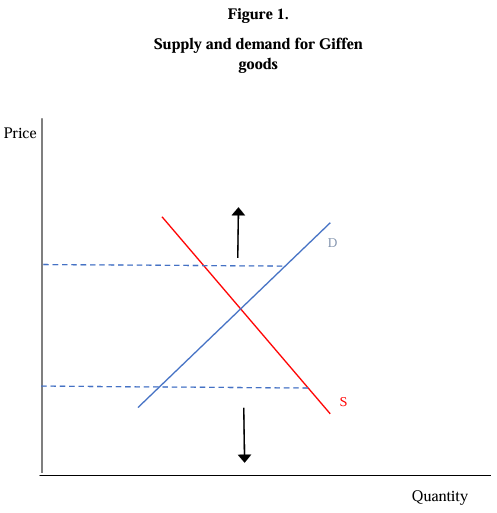
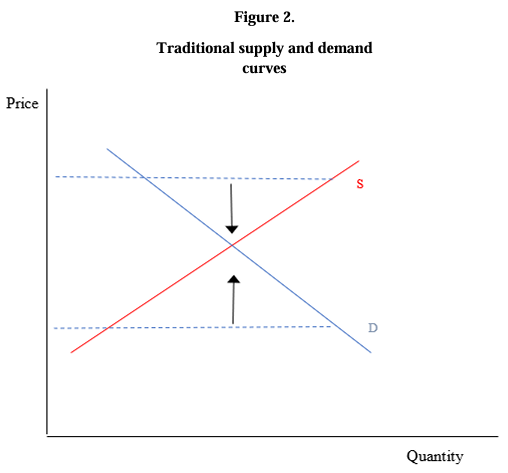
The implications of the consensus view on these two concepts are irrational. For if true, the BBSCL implies a downward sloping supply curve, and that of the GG leads inexorably to an upward sloping demand curve. But this is highly problematic. For, assume such a state of affairs. When supply is greater than demand, as it would be when prices are below the “equilibrium” point,3 then they would go down, down, down (figure 1). Indeed, there is no reason to rule out the possibility that they would fall to minus infinity, whatever that would mean. Similarly, when prices are above “equilibrium” in the BBSCL and GG world (figure 1), they would shoot up, up, up, all the way, presumably, to infinity, again, whatever that would mean. In contrast, with normally sloped curves (figure 2), when price is below equilibrium, demand is greater than supply, and prices rise, toward equilibrium. Of course, with the traditional upward sloping supply and downward sloping demand curves (figure 2), prices above the point where supply and demand meet would tend to fall, not to zero or minus infinity, but to equilibrium.
So, he who supports the GG serves as a partial backing for this economic irrationality. Ditto for those who aid and abet the BBSCL. An economist who trucks in both4 is in effect a full time espouser of the theoretical coherence and perhaps empirical existence5 of swings from positive to negative infinity, and back again.
IV. BBSCL
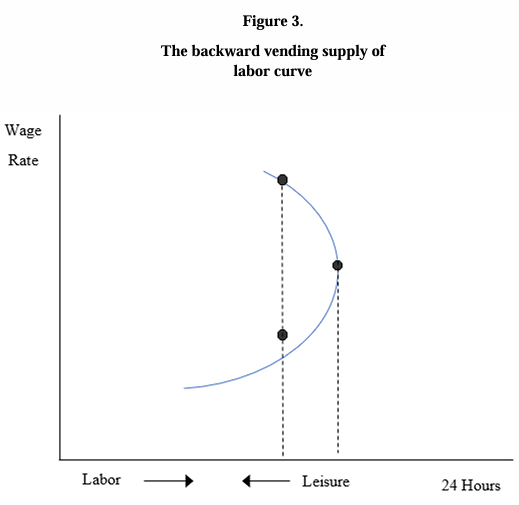
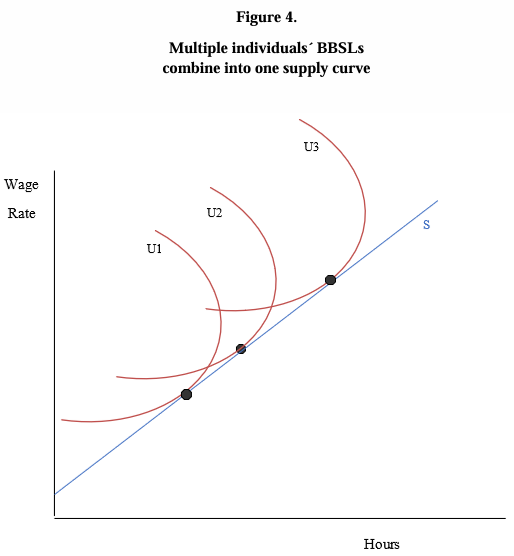
How can we obviate this threat to all that is good and true, and realistic, in economics? The usual reason for supporting the existence of backward bending supply curves of labor is the case of a person given a raise, and at the higher wage preferring to work less than before, not more, since he desires additional leisure, a good he sees as complimentary to his now additional funds. That is, at some point (see point A in figure 3) leisure becomes a normal good. How, then, can we turn this individual BBSCL into a forward looking one, so that the variations between positively and negatively infinite wages can be avoided? The answer emanating from the neoclassicals is that while each individual supply curve will be backward bending, the sum total of them will not be. For, as wages rise, new entrants will enter the market, combining individual BBSCLs with an upward sloping market one (figure 4).
This critique of the backward bending supply curve is that as one worker reduces the number of hours offered to employers at that higher wage, another person will enter the market, so that the individual BBSCLs would not translate into one for the entire economy. But what if the wages of all workers rise? Is not it true that people overall might well work less if all wage rates rose, say, to $1,000,000 an hour?6 It is exceedingly difficult to avoid this conclusion. Thus, this obviation of the BBSCL, based on the distinction between individual and market supply curves, cannot be judged to be an entire success.
How, then, are we to undermine this BBSCL for the entire market which implies at least at some range, a downward sloping supply curve? And, also, we must obviate the Giffen good, lest we become enmeshed in the upward sloping demand curve. Let us consider the latter first.
V. GG
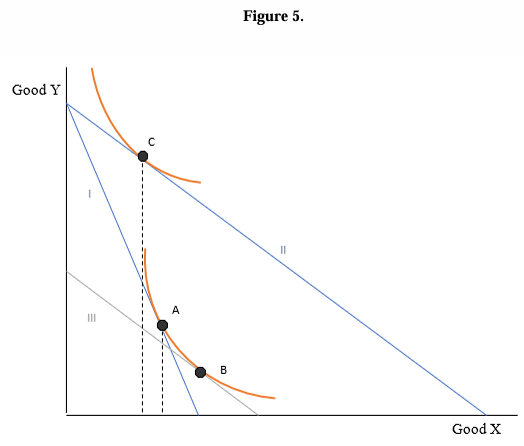
In order to see this, let us now examine how we can challenge the Giffen Good, a concept equally “guilty” of fomenting an unstable supply and demand relationship (figure 5).7
What is the GG? In figure 5, budget line II indicates a lower price of X than budget line I (since if all money is spent on X, more can be purchased where II intersects the X axis than where I hits it). The substitution effect is from A to B, necessarily in the direction of more expenditure on X, as long as the indifference curve is convex to the origin. The income effect is from B (on budget line III, parallel to II) to C. Here, the income effect is stronger than the substitution effect, the unique requirement of the GG. Thus, the consumer spends less on X at II (point C) with a lower price, than at II (point A) at a higher price, indicating an upward sloping demand curve. This is the precise definition of the GG.
What is the Austrian88 rejection of the Giffen Good’s creation of an upward sloping demand curve? Both demand and supply curves are supposed to be drawn on the assumption that only two things change as a movement along them occurs: price and quantity. The problem with the Giffen good, which yields an upward sloping demand curve, is that something else changes as we move along it: namely, income. In contrast, the Austrian demand curve, where neither income, nor anything else, changes as one moves along it, is not vulnerable to this Giffen good – upward sloping demand curve. No, (Austrian) demand curves slope downward, period, and this is a praxeological necessity.9
VI. BBSCL
A similar analysis can now be applied to the supply curve. If one person’s income changes, as a practical matter we can pretty much ignore this when drawing up a supply curve of labor for the entire economy; at least that is what the neoclassicals do. But when we posit that everyone’s income does this, then, certainly, we cannot ignore this, even as a practical matter. So, we now borrow a leaf from the Austrian analysis of demand curves and apply it to our scenario of vastly increasing wages: The Austrian supply curve, like its demand curve, abstracts from everything else except prices (wages in this case) and quantity. For the demand curve, if incomes rise, it shifts, to the right for normal goods, to the left for inferior goods. Similarly, if incomes rise, and people want more leisure, then the supply curve shifts to the left. There is no backward bending part of it, which is equivalent to a downward sloping supply curve, forsooth.
VII. A complication
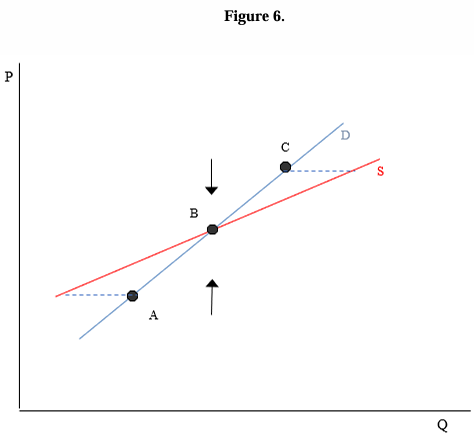
In figure 1 we demonstrated that Giffen Goods create an absurd situation in which prices other than precisely at equilibrium can make them shoot up to infinity, or down to negative infinity. However, if the income effect is strong enough that the positively sloped demand curve is steeper than the supply curve (see figure 6), a real equilibrium once again becomes possible.1010 At point A demand is greater than supply, driving prices, as well as demanded and supplied quantity up towards equilibrium. Similarly, at point C supply is greater than demand leading to a reduction in price causing both supply and demand to fall to the equilibrium level. Point B, then, in figure 6 is a stable equilibrium point, even with an upward sloping (GG type) demand curve.
What if supply is steeper than demand? In Figure 7 we depict the demand curve for a good, which has Giffen characteristics (upward sloping) up until point N. then, as price moves higher, the demand curve becomes normal (downward sloping). After this certain price and quantity, N, all the consumer’s income will be allocated to the Giffen Good, and further increases in price will necessarily lead to a reduction in demanded quantity (points N to P). This means consumers would have upward sloping (for lower prices) and then backward bending (for higher price) demand curves, or USBBDCs for short.
At point K the price is lower than the disequilibrium point (L), and demand is less than supply. Therefore, price will fall, again to minus infinity. This is not plausible because both supply and demand would fall to minus infinity, whatever that means. If we land and point L, and nothing else changes, no shift in supply or demand, then the market will stay there; but this is problematic, because supply and demand curves are always and ever shifting.
At point M (as any other point between L and N), demand is upward sloping and greater than supply, leading to increases in price, supply, and demand. At point N and above the individual allocates all of his income in this specific good (yet another unrealistic scenario), and the demand curve starts to resemble the traditional format (downward sloping).As price continues to rise between N and O quantity demanded will diminish, quantity supply will increase, until equilibrium is reached at point O. Notice that any point between L and O will lead to the equilibrium point O. At point P the USBBDC behaves like a traditional supply and demand model, and greater supply than demand will cause prices to fall. This will go on until equilibrium is once again reached at O.
VIII. Conclusion
Making a distinction between the individual versus the market backward bending supply curve is a good start. Brought to us by the neo-classical economists, it is an attempt to show that market supply curves of labor effort can be upward sloping, even in the context of the BBSCL on the part of the individual. But, it founders in the face of the scenario where everyone’s income goes through the roof.11 Then, if this were all there were to the
matter, market supply curves would also be backward bending.
However, the greater depth of the Austrian analysis applies not only to the individual supply curve but to that for the market as well. It says that here too that the only variables that may be altered are price (wages are the price of labor) and quantity. But both the market and the individual BBSCL allow a third observation to vary other than legitimate price (wage) and quantity of labor: also, income. When we abstract from that occurrence, we arrive at curve shifts, not movements along weirdly and irrationally shaped supply and demand curves.
References
Barnett, W. (2003). The Modern Theory of Consumer Behavior: Ordinal or Cardinal? The Quarterly Journal of Austrian Economics, 6(1), 41–65. Retrieved from http://www.qjae.org/journals/qjae/pdf/qjae6_1_3.pdf
Barnett, W. & Block, W. (2010). Mises never used demand curves; was he wrong? Ignorant? No: The Antimathematicality of Demand Curves. Dialogue, 1, 23-31. Retrieved from http://www.uni-svishtov.bg/dialog/title.asp?lang=en&title=101
Barzel, Y. & McDonald, R. (1973). Assets, Subsistence, and The Supply Curve of Labor. The American
Economic Review. 63(4), 621-633. Retrieved from: http://www.jstor.org/stable/1808853?seq=1#page_scan_tab_contents:
Battalio, R., Kagel, J., & Kogut, C. (1991). Experimental Confirmation of the Existence of a Giffen Good. The American Economic Review, 81(4), 961-970. Retrieved from http://www.jstor.org/stable/2006656?seq=1#page_scan_tab_contents
Block, W. (1980). On Robert Nozick’s ‘On Austrian Methodology’. Inquiry, 23 (4), 397. Retrieved from http://www.walterblock.com/publications/on_robert_nozick.pdf; Spanish translation, Libertas, Vol. 14, No. 26, May 1997, pp. 71-131
Block, W. (1999). Austrian Theorizing, Recalling the Foundations: Reply to Caplan. Quarterly Journal of Austrian Economics, 2(4), 21-39. Retrieved from http://www.mises.org/journals/qjae/pdf/qjae2_4_2.pdf. Errata: http://www.mises.org/journals/qjae/pdf/qjae2_4_9.pdf
Block, W. (2003). Realism: Austrian vs. Neoclassical Economics, Reply to Caplan. Quarterly Journal of Austrian Economics, 6(3), 63-76. Retrieved from http://www.mises.org/journals/qjae/pdf/qjae6_3_4.pdf
Block, W. (2007). Reply to Caplan on Austrian Economic Methodology. Corporate Ownership Control, 4(2), 312-317. Retrieved from http://www.virtusinterpress.org/additional_files/journ_coc/issues/COC_(Volume_4_Iss
ue_3_Spring_2007_Continued2).pdf
Block, W. (2009a). Rejoinder to Hoppe on indifference. Quarterly Journal of Austrian Economics, 12(1), 52–59.
Retrieved from: http://mises.org/journals/qjae/pdf/qjae12_1_4.pdf
Block, W. (2009b). Rejoinder to Machaj on Indifference. New Perspectives on Political Economy, 5(1), 65–71. Retrieved from http://pcpe.libinst.cz/nppe/5_1/nppe5_1_5.pdf
Block, W. (2012). Thymology, praxeology, demand curves, Giffen goods and diminishing marginal utility. Studia Humana, 1(2), 3-11. Retrieved from: http://studiahumana.com/pliki/wydania/Thymology,%20praxeology,%20demand%20cu
rves,%20Giffen%20goods%20and%20diminishing%20marginal%20utility.pdf;
http://studiahumana.com/art,The-second-issue,Thymology-Praxeology-Demand
Curves-Giffen-Goods-and-Diminishi.html
Block, W., & Barnett, W. (2010). Rejoinder to Hoppe on indifference, once again. Reason Papers, 32, 141-154. Retrieved from http://reasonpapers.com/pdf/32/rp_32_9.pdf
Block, W., & Barnett, W. (2012). Giffen Goods, Backward Bending Supply Curves, Price Controls and Praxeology; or, Who’s Afraid of the Big Bad Boogie Man of Giffen Goods and Backward Bending Supply Curves? Not Us. Revista Procesos de Mercado, 9(1), 353
Böhm-Bawerk, E. ([1909] 1959) Capital and Interest. 3 vols. South Holland, IL: Libertarian Press.
Callahan, G. (2003, February 10). Choice and Preference. Retrieved from http://mises.org/story/1163
Caplan, B. (n.d). Why I am not an Austrian Economist. Retrieved from http://www.gmu.edu/depts/economics/bcaplan/whyaust.htm
Caplan, B. (1999). The Austrian Search for Realistic Foundations. Southern Economic Journal, 65(4),
823-838. Retrieved http://www.gmu.edu/departments/economics/bcaplan/ausfin2.doc
from
Caplan, B. (2001). Probability, Common Sense, and Realism: A Reply to Huelsmann and Block. Quarterly Journal of Austrian Economics, 2(4), 69-86. Retrieved from http://www.mises.org/journals/qjae/pdf/qjae4_2_6.pdf
Caplan, B. (2003). Probability and the Synthetic A Priori: A Reply to Block. Quarterly Journal Austrian Economics; 6(3), 77-83. Retrieved from http://www.mises.org/journals/qjae/pdf/qjae6_3_5.pdf
Caplan, B. (2008, June 16). The Trojan Horse Example. Retrieved from http://econlog.econlib.org/archives/2008/06/the_trojan_hors.html
Dougan, W. (1982). Giffen Goods and the Law of Demand. Journal of Political Economy. 90(4), 809-815. Retrieved from http://www.jstor.org/stable/1831354?seq=1#page_scan_tab_contents
Dessing, M. (2002). Labor supply, the family and poverty: The S-shaped labor supply curve. Journal of Economic Behavior & Organization, 49(4), 433–458. Retrieved from http://www.sciencedirect.com/science/article/pii/S0167268102000112
Dwyer, G., & Lindsay, C. (1984). Robert Giffen and the Irish Potato. The American Economic Review, 74(1), 188-192. Retrieved from https://www.jstor.org/stable/1803318?seq=1#page_scan_tab_contents
Gronau, R. (1973). The Intrafamily Allocation of Time: The Value of the Housewives’ Time. The American Economic Review, 63(4), 634-651. Retrieved from http://www.jstor.org/stable/1808854?seq=1#page_scan_tab_contents
Hanoch, G. (1965). The ‘Backward-bending’ Supply of Labor. Journal of Political Economy, 73(6), 636-642. Retrieved from http://www.jstor.org/stable/1829888?seq=1#page_scan_tab_contents
Hayek, F. (1967). Prices and Production. 2nd ed. New York: Augustus M. Kelley, Publishers.
Hoppe, H. (2005). A Note on Preference and Indifference in Economic Analysis. The Quarterly Journal of Austrian Economics, 8(4), 87-91. Retrieved from http://mises.org/journals/qjae/pdf/qjae8_4_6.pdf
Hoppe, H. (2009). Further Notes on Preference and Indifference: Rejoinder to Block. The Quarterly Journal of Austrian Economics, 12(1), 60-64. Retrieved from http://mises.org/journals/qjae/pdf/qjae12_1_5.pdf
Huang, Y. (1976). Backward‐bending supply curves and behaviour of subsistence farmers. The Journal of Development Studies, 12(3), 191-211. Retrieved from http://www.tandfonline.com/doi/abs/10.1080/00220387608421576
Hülsmann, J. (1999). Economic Science and Neoclassicism. Quarterly Journal of Austrian Economics, 2(4), 1-20. Retrieved from http://www.mises.org/journals/qjae/pdf/qjae2_4_1.pdf
Lancaster, K. (1966). A new approach to consumer theory. Journal of Political Economy. 74, 132-157. Retrieved
http://www.jstor.org/stable/1828835?seq=1#page_scan_tab_contents
Lin, C. (2003). A backward‐bending labor supply curve without an income effect. Oxford Economic Papers. 55(2), 336-343.Retrieved from http://oep.oxfordjournals.org/content/55/2/336.short
Lipsey, R. & Rosenbluth, G. (1971). A contribution to the new theory of demand: a rehabilitation of the Giffen good. The Canadian Journal of Economics, 4(2), 131-163. Retrieved from http://www.jstor.org/stable/133523?seq=1#page_scan_tab_contents
Machaj, M. (2007). A Praxeological Case for Homogeneity and Indifference. New Perspectives on Political Economy, 3(2), 231-238. Retrieved from http://pcpe.libinst.cz/nppe/3_2/nppe3_2_5.pdf
Marrewijk, C., & Bergeijk, P. (1990). Giffen Goods and the Subsistence Level. History of Economy, 22(1), 145-148. Retrieved from: http://hope.dukejournals.org/content/22/1/145.citation
Menger, C. ([1871] 1976) Principles of Economics. New York: New York University Press.
Miracle, M., & Fetter, B. (1970). Backward-Sloping Labor-Supply Functions and African Economic Behavior. Economic Development and Cultural Change, 18(2), 240-251. Retrieved from http://www.jstor.org/stable/1152613?seq=1#page_scan_tab_contents
Mises, L. [1949] 1998. Human Action, Scholars’ Edition. Auburn: Ludwig von Mises Institute. http://mises.org/resources/3250
Nachbar, J. (1998). The last word on Giffen goods? Economic Theory, 11(2), 403–412. Retrieved from http://link.springer.com/article/10.1007/s001990050193
Nozick, R. (1977). On Austrian Methodology. Synthese, 36, 353-392. Reprinted in Socratic puzzles. Harvard University Press, 1997
O’Neill, B. (2010). Choice and Indifference: A Critique of the Strict Preference Approach. Quarterly Journal of Austrian Economics, 13(1), 71–98. Retrieved from http://mises.org/journals/qjae/pdf/qjae13_1_4.pdf
Rothbard, M. (2004 [1962]). Man, Economy and State, Scholar’s Edition. Auburn, AL.: Ludwig von Mises Institute. http://www.mises.org/rothbard/mes.asp
Sørensen, P. (2007). Simple Utility Functions with Giffen Demand. Economic Theory, 31(2), 367–370. Retrieved from http://link.springer.com/article/10.1007%2Fs00199
006-0086-6?LI=true
Spiegel, U. (1994). The Case of a ‘Giffen Good’. The Journal of Economic Education, 25(2), 137-147. Retrieved
from: http://www.tandfonline.com/doi/abs/10.1080/00220485.1994.10844823?journalCode=vece20
Weber, C. (1997). The Case of a Giffen Good: Comment. The Journal of Economic Education, 28(1), 36-44. Retrieved from http://www.tandfonline.com/doi/abs/10.1080/00220489709595904?journalCode=vece20
Figures
- Those in this profession who have published refereed journal articles which exemplify that assessment of
theirs include: Barzel and McDonald, 1973; Dessing, 2002; Gronau, 1973; Hanoch, 1965; Huang, 1976;
Lin, 2003; Miracle and Fetter, 1970 ↩︎ - Economists who agree with this viewpoint and have done so in print in the periodicals of this profession,
include: Battalio, Kagel and Kogut, 1991; Dougan, 1982; Dwyer and Lindsay, 1984; Lancaster, 1966;
Lipsey and Rosenbluth, 1971; van Marrewijk and van Bergeijk. 1990; Nachbar, 1998; Sørensen, 2007;
Spiegel, 1994; Weber, 1997. ↩︎ - Scare quotes around the word “equilibrium” are placed there to indicate the point where the two curves
cross is a disequilibrium point, not one of equilibrium. ↩︎ - Presumably, virtually every economist ↩︎
- This is less likely ↩︎
- I owe this point to Nathan Fryzek ↩︎
- For the Austrian critique of indifference, and indifference curves see Barnett, 2003; Block, 1980, 1999,
2003, 2007, 2009A, 2009B, Block and Barnett, 2010; Hoppe, 2005, 2009; Hulsmann, 1999; Machaj, 2007;
O’Neill, 2010. For a critique of the Austrian position, see Caplan, undated, 1999, 2001, 2003, 2008; Nozick,
1977 ↩︎ - The Austrian school of economics is based on the works of Menger (1871), Bohm-Bawerk (1909), Mises
(1949), Hayek (1935) and Rothbard (1962). It has as little to do with the economics of the country, Austria,
as does the Chicago school of economics with that city. ↩︎ - For a reservation regarding this sentence, see Barnett and Block, 2010. ↩︎
- Even with the Giffen good, as depicted here with that positive slope. ↩︎
- Robots, computers and high technology may one day make this more realistic than it sounds at the time
of the present writing. ↩︎
*Walter E. Block, Ph.D. Harold E. Wirth Eminent Scholar Endowed Chair and Professor of Economics.
Joseph A. Butt, S.J. College of Business. Loyola University New Orleans, 6363 St. Charles Avenue, Box
15, Miller Hall 318 New Orleans, LA 70118. tel: (504) 864-7934. fax: (504) 864-7970. wblock@loyno.edu.
Gabriel Philbois. Joseph A. Butt, S.J. College of Business. Loyola University New Orleans, 6363 St.
Charles Avenue. New Orleans, LA 70118. gpphilbo@loyno.edu; gabriel.philbois@gmail.com
The author thanks Nathan Fryzek, whose inquiries led him to write the present paper. All responsibilities
for errors of course rest with the present author.